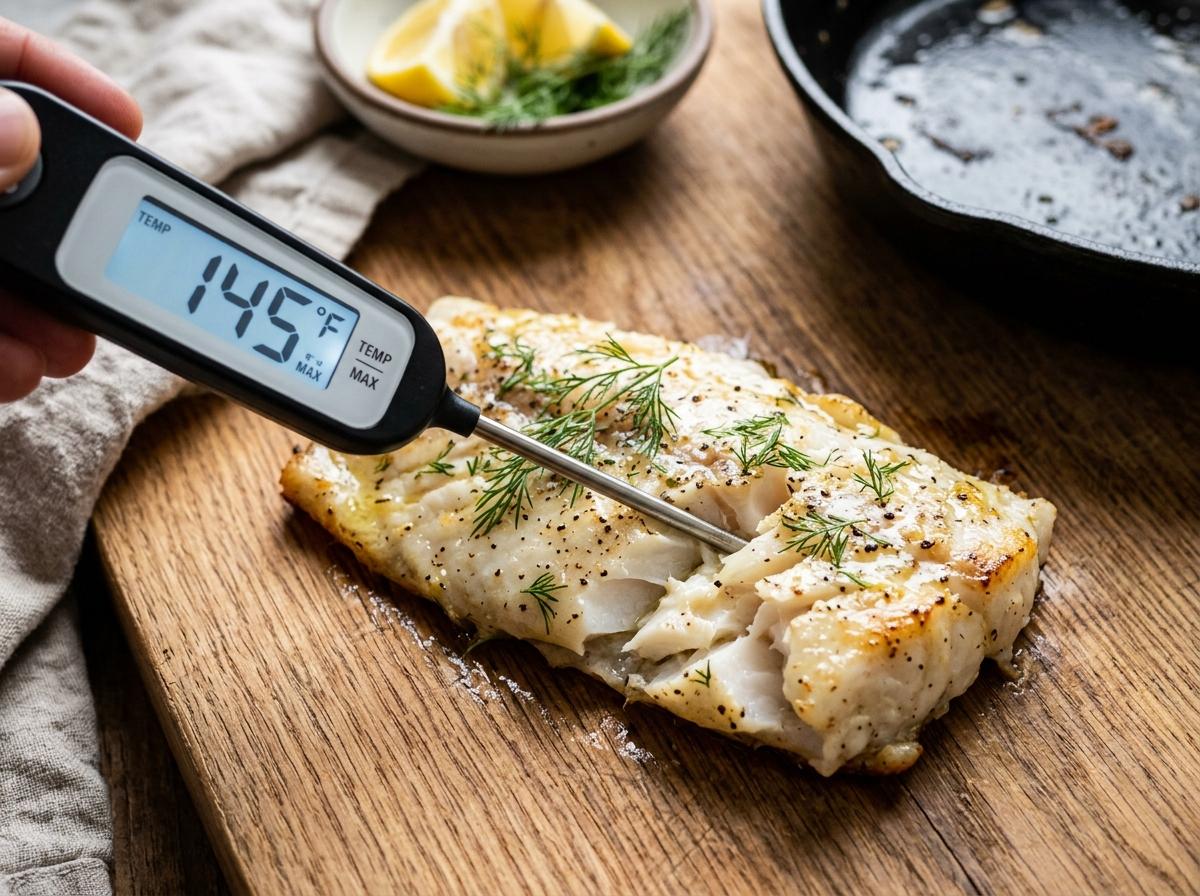
The best cooked cod temperature is 145°F (63°C) at the thickest part of the fish.
That’s the number most home cooks should use. It matches USDA food safety guidance for fin fish, and it also gives cod that classic flaky texture people want.
Here’s the simple version. If the center of your cod reaches 145°F, the flesh should look opaque, separate easily with a fork, and still taste moist if you haven’t left it on the heat too long.
A lot of people mix up cooking temperature and internal temperature. Your oven might be set to 400°F, but the cod itself isn’t “done” because of the oven setting. It’s done because the inside of the fish reaches the right temp.
Quick fact: The term cooked cod temperature means the internal temperature in the thickest part of the fillet, measured with an instant-read thermometer.
If your cod keeps coming out dry, bland, or rubbery, the problem usually isn’t your seasoning. It’s that the fish stayed on the heat a little too long.
Why 145°F Works So Well
The food safety number
For home cooking, 145°F is the safe target to remember.
The USDA recommends cooking fish to 145°F. At that point, the flesh turns opaque and flakes easily. That gives you a clear food safety number instead of relying only on looks.
That matters even more if you’re cooking for:
- kids
- older adults
- pregnant guests
- anyone with a weaker immune system
In those cases, don’t play around with lower numbers you may see in chef forums or social media clips. Stick with 145°F.
Food safety note: This is general kitchen guidance, not medical advice. If someone in your home has special health concerns, follow current food safety advice from trusted health sources.
The texture sweet spot
Safety is one part of the story. Texture is the other.
Cod is a lean white fish. It doesn’t have much fat to protect it from overcooking. Salmon has more room for error because it’s richer. Cod doesn’t.
That’s why a few degrees matter so much.
At the right temp, cod feels tender and breaks into clean flakes. Push it much past that point, and the muscle fibers tighten up. The fish starts losing moisture fast. That’s when you get that dry, stringy bite that makes people say, “Why does my cod always taste boring?”
A common misconception is that fish should cook until it feels very firm. That’s usually too late. Done cod should still feel gentle and juicy, not stiff.
Another common mistake? Assuming the fish is ready just because the edges flake. The thinner edges almost always cook before the center does.
If you cook other mild fish too, the same rule shows up in our guides to halibut internal temp and tilapia done temp: the thickest part tells the truth.
Should you pull cod off the heat before 145°F?
You can, but only if you understand carryover cooking.
A thick cod loin may rise a few degrees after you take it off the stove or out of the oven. In that case, some cooks pull it around 142°F to 143°F, then let it rest for 2 to 3 minutes.
That said, carryover heat in fish is usually smaller than it is in a roast or steak, especially with thin fillets. So if your cod pieces are thin, it’s safer and simpler to check for 145°F before serving.
If you’re new to cooking fish, keep life easy. Aim for 145°F and you’ll be in good shape.
How to Check Cod Temperature the Right Way
Where to place the thermometer
A thermometer only helps if you use it in the right spot.
The best place to check cod is the thickest part of the fillet, usually near the center. Insert the probe from the side if you can. That lets you reach the middle more accurately without pushing all the way through.
Here’s the easiest method:
- Put the probe into the thickest section.
- Aim for the center of the flesh.
- Don’t let the tip touch the pan, tray, or grill grate.
- Wait a few seconds for the reading to settle.
If the fillet is uneven, check in two spots. Use the lower reading.
Pro tip: Side entry works better than stabbing straight down from the top. You get a truer reading of the center, especially on thinner fish.
What if you don’t have a thermometer?
You can still judge cod by sight and feel, but you’ll lose some accuracy.
Done cod usually shows a few clear signs:
- the flesh turns opaque instead of glassy
- the fish flakes with gentle pressure
- the center no longer looks raw or wet
- a knife slips in with little resistance
Still, these signs can fool you.
A sauced fillet may look softer than it is. A very fresh, thick piece of cod can stay slightly pearly right before it finishes. Breading can hide the surface. A hot pan can brown the outside while the middle lags behind.
That’s why an instant-read thermometer is such a useful little tool. It removes the guesswork.
If you’re frying fish, timing helps too, and our post on how long to fry fish can give you a good starting point. Just don’t stop at timing alone. Temperature still decides doneness.
Salmon gives different visual cues because it has more fat and darker flesh. If you switch between fish often, this guide on how to know when salmon is done helps show why cod and salmon shouldn’t be judged the exact same way.
Best Cooked Cod Temperature by Cooking Method
The target stays the same across methods: 145°F in the thickest part.
What changes is how fast cod gets there.
Thickness matters more than weight. A short, thick cod loin may need more time than a wide but thin fillet that weighs the same.
Here’s a simple reference for a 1-inch-thick cod fillet:
| Method | Cooking heat | Approx time | Final temp |
|---|---|---|---|
| Bake | 400°F oven | 10–12 min | 145°F |
| Pan-sear | Medium to medium-high | 6–8 min total | 145°F |
| Grill | Medium heat | 8–10 min | 145°F |
| Air fryer | 375–400°F | 8–11 min | 145°F |
Use those times as a guide, not a promise. Your fillet, pan, and oven will always have the final say.
Did you know? A cod fillet can go from just right to dry in about 2 minutes, especially if it’s thin.
Baked cod
Baking is one of the easiest ways to cook cod well.
A 400°F oven works nicely for most fillets. It gives you enough heat to cook the fish fairly quickly without drying the surface too fast.
For a standard 1-inch fillet, start checking around the 8-minute mark. Many pieces finish somewhere between 10 and 12 minutes. Thick cod loins may take a bit longer.
If you’re baking cod with butter, lemon, garlic, or herbs, the finish temp doesn’t change. The center still needs to reach 145°F.
A quick real-life example helps. Say you have a 6-ounce Atlantic cod loin, about 1 inch thick. You bake it at 400°F on a sheet pan. Around minute 9, it may still be around 130°F to 135°F. By minute 11, it may jump to 142°F or 145°F. That last stretch happens fast.
That’s why checking early matters.
A few small baking tips make a big difference:
- Pat the fish dry before seasoning.
- Use a little oil or melted butter so the surface doesn’t dry out.
- Leave space between fillets on the tray.
- Don’t wait for the fish to look “very firm.”
If you bake cod in foil or parchment, the steam can keep it tender. Still, steam can also hide visual doneness cues, so a thermometer becomes even more helpful.
Pan-seared cod
Pan-seared cod is great when you want a golden crust and soft interior.
Use a skillet over medium or medium-high heat. Add oil, then place the cod in the pan once the surface is hot. A 1-inch fillet often takes about 3 to 4 minutes on the first side and 2 to 3 minutes on the second.
The outside browns quickly in a skillet. That looks promising, but it can trick you. The center may still be underdone.
Check the temperature from the side during the last minute or two. You’re looking for 145°F in the middle.
If the fillet is thick, lower the heat after the first sear. That gives the center time to catch up without burning the crust.
One more thing: cod sticks when you try to move it too early. Let the fish form a crust before flipping. If it clings hard to the pan, give it another 20 to 30 seconds.
A little butter at the end works well, but don’t drown the fish too early. Too much liquid in the pan can make the crust soggy.
Grilled cod
Cod can be excellent on the grill, though it needs a bit more care than salmon.
Since cod is delicate, thick center-cut pieces work best. Thin tail sections can break apart or overcook before you even get nice grill marks.
Use medium heat and oil the grates well. A fish basket or foil tray makes life easier if you’re worried about sticking.
Most cod fillets grill in 8 to 10 minutes total, depending on thickness. Some need one flip. Some don’t, especially if you’re using a grill basket.
Start checking early. Grills can run hotter than you think, and direct heat dries lean fish fast.
If you already cook other seafood outdoors, you’ll notice cod behaves differently from rich fish. Salmon can take stronger heat because of its fat. Cod needs a lighter touch.
Air-fried or frozen cod
Air fryers work very well for cod because they cook fast and give a nice surface without much oil.
Fresh cod often cooks at 375°F to 400°F for around 8 to 11 minutes. Frozen cod usually needs a few extra minutes, often 12 to 15 minutes, depending on thickness and whether the fillet is breaded.
The final target stays the same: 145°F.
If you’re cooking frozen cod straight from the freezer, check the center carefully. The outside can look done before the middle fully catches up.
If you thaw seafood ahead of time, safe fridge timing matters too. While it focuses on salmon, our guide on thawed salmon in the fridge explains the same planning mindset that helps with thawed fish in general.
Mistakes That Make Cod Dry, Tough, or Underwhelming
Cooking by time alone
Recipes love to say things like “bake for 12 minutes” or “sear 4 minutes per side.”
That’s helpful, but it’s not the whole story.
A thin supermarket fillet, a thick cod loin, and a frozen piece all behave differently. Even two pieces from the same pack may finish at different times.
Use time as a rough map. Use temperature as the final answer.
Leaving it on the heat too long
Cod doesn’t give you a big warning before it crosses the line.
One minute it looks almost there. A minute later, it’s dry. Since cod is lean, overcooking shows up fast in texture.
Start checking before you think it’s done, not after.
If you wait until the fish is fully rigid and breaking into dry chunks, you’ve already gone past the sweet spot.
Starting with a wet surface
Surface moisture slows browning and encourages steaming.
That doesn’t mean steamed fish is bad. It just means you may overcook the center while waiting for color or crust on the outside.
Pat the cod dry with paper towels before seasoning. That tiny step helps more than people expect.
Ignoring uneven thickness
Most fillets aren’t the same thickness from end to end.
The tail side cooks faster. The thick center takes longer. If you cook the whole fillet as if it were even, one end may dry out before the other finishes.
You can fix that by folding the thin end under itself or simply checking the thickest part earlier and pulling the fish as soon as it’s ready.
Assuming flaky always means perfect
Flaky is good, but only if it happens at the right moment.
A cod fillet can flake and still be dry. It can also start flaking at the edges while the center isn’t quite there yet.
Think of flaking as one clue, not the only clue.
Warning: Don’t use color alone to judge cod if it’s covered in breadcrumbs, sauce, miso glaze, or a creamy topping. Those extras hide what’s happening inside.
Serving, Storing, and Reheating Cooked Cod
Cod tastes best right after cooking, especially because it’s so lean.
Let it rest for about 2 minutes after cooking. That gives the juices a moment to settle and helps the flakes stay neat instead of breaking apart all over the plate.
If you have leftovers, refrigerate them within 2 hours. Keep them in a sealed container and use them within 3 to 4 days.
That storage window is close to what we cover in cooked salmon in the fridge, and it’s a good general rule for cooked fish.
Reheating cod takes a gentle hand. A low oven, covered dish, or soft reheat in a skillet works better than blasting it in high heat. If you want the safest route for leftovers, general USDA leftover guidance uses 165°F for reheating, though that can dry fish if you’re not careful.
One smart move is to use leftover cod in fish tacos, rice bowls, or a light curry sauce. Moist heat helps protect the texture better than dry reheating.
4. FAQ Section
What temperature should cod be cooked to?
Cod should be cooked to an internal temperature of 145°F (63°C) at the thickest part. That’s the safest and most reliable target for home cooks.
Is cod done at 130°F or 135°F?
For home cooking, no. Some restaurant chefs may talk about lower pull temps, but the standard safe target for cod is 145°F. If you want less guesswork and better food safety, stick with that number.
Do you take cod off the heat at 145°F or before?
If the fillet is thick, you can pull it around 142°F to 143°F and let it rest for a couple of minutes, since carryover heat may finish the job. If the piece is thin, it’s better to check for 145°F before serving because fish doesn’t always carry over much.
How long do you bake cod at 400°F?
A 1-inch cod fillet usually takes about 10 to 12 minutes at 400°F. Thick pieces may need longer. Thin pieces may finish faster. Start checking early and use temperature, not the clock, as your final guide.
Is cod done when it flakes with a fork?
Flaking is a useful sign, but it isn’t perfect on its own. The edges of the fish may flake before the center is fully cooked. The best check is still an instant-read thermometer showing 145°F.
Can cod be slightly translucent in the middle?
Right before it finishes, cod can look a little pearly in the center. Once it reaches 145°F, the middle should no longer look raw or glassy. If you’re unsure, check the temperature instead of guessing from color.
Can you cook cod from frozen?
Yes, you can cook cod from frozen. You’ll just need more time. The final internal temperature is still 145°F. Frozen fillets often release extra moisture, so don’t trust surface appearance alone.
5. Conclusion
If you remember one number, make it 145°F. That’s the cooked cod temperature that keeps your fish safe and gives you the best shot at tender, flaky results. Start checking a little early, use the thickest part of the fillet, and don’t wait for the fish to look bone-dry before pulling it.
Next time you cook cod, skip the guesswork. Grab a thermometer, check at the center, and let that small habit do the heavy lifting. Once you nail cod, every white-fish dinner gets a whole lot easier.