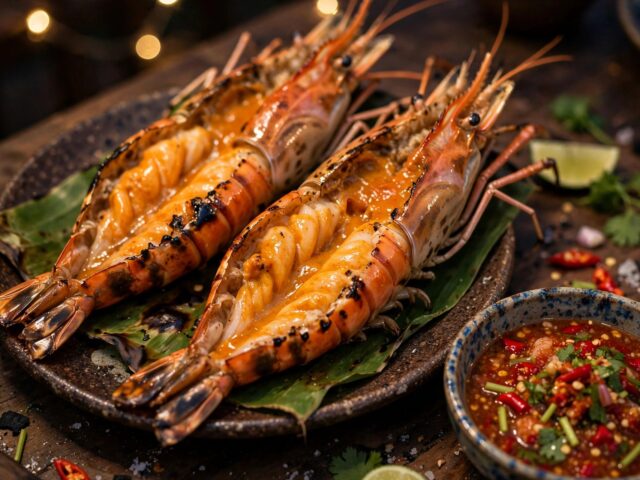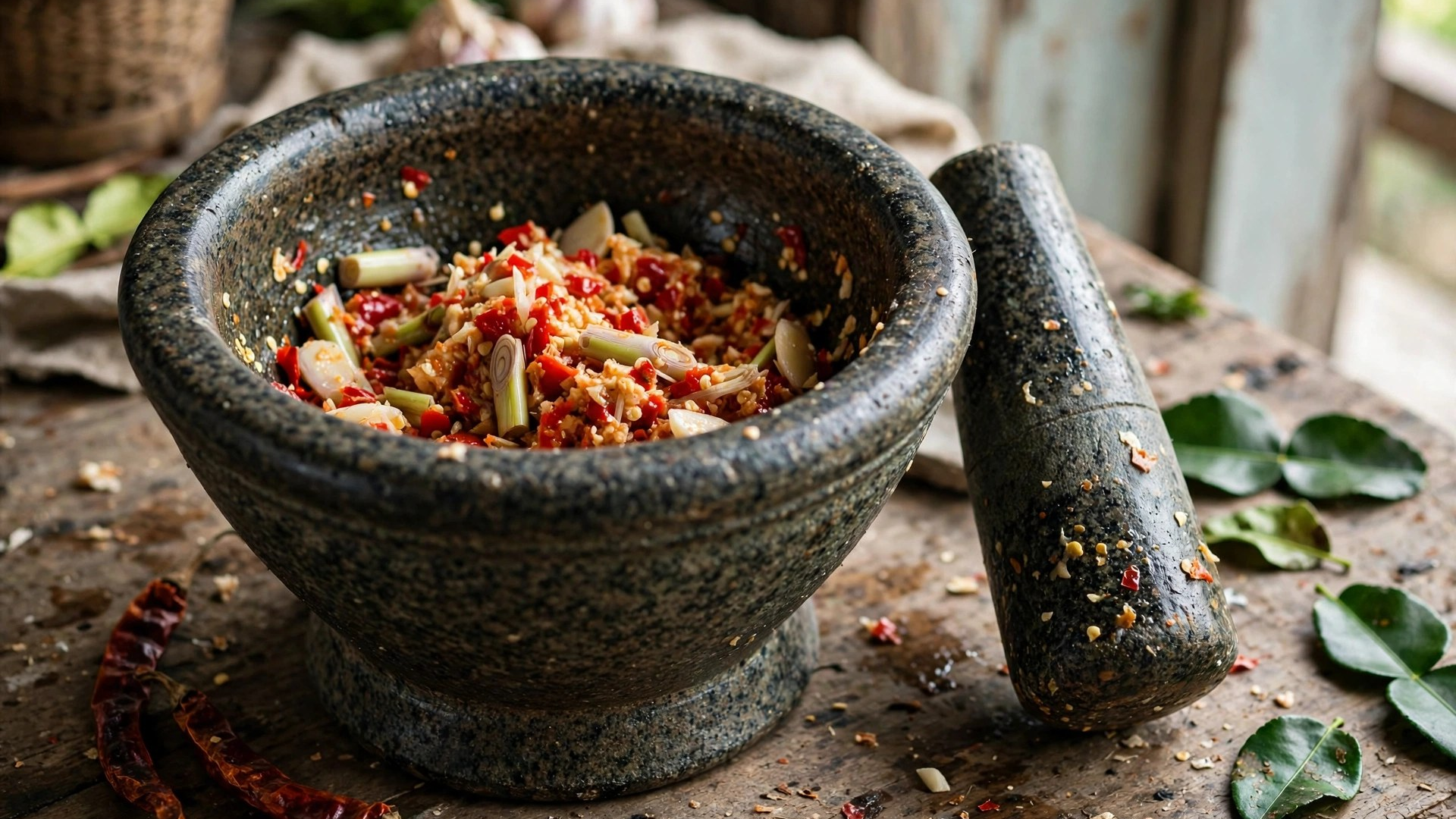
There is a whole category of Thai food that most of the world has never met — including people who eat Thai food every week. It is not a curry or a noodle dish or a salad. It is a small bowl of something pounded: chilies, aromatics, fermented fish or shrimp paste, herbs, ground together into something intensely flavored, set in the middle of the table with plain rice and a spread of vegetables. In Thai it is called nam phrik, and in the Thai kitchen it is not a side dish or a garnish. It is the dish.
Ask a Thai cook to name the varieties and you will be there a while. There are well over a hundred, and they change by region, by season, by family. The basic idea never changes, though: something powerfully seasoned, made in a mortar, eaten with rice and vegetables. This is a beginner’s tour of the landscape — the great regional families, what each one tastes like, and where to start.
One thing to clear up first. On nearly every Thai table sits a small saucer of fish sauce with sliced chilies — nam plaa phrik — the rough equivalent of the salt shaker, there to adjust seasoning bite by bite. That is a condiment. A true nam phrik is a complete recipe, a dish in its own right, with its own name and its own following. The tour starts here.
The North: mild, vegetable-forward, built for sticky rice
Northern Thai food — the Lanna cooking of Chiang Mai and the surrounding provinces — loves its vegetables, and its relishes are built around them. The two great northern relishes could not be more different from each other, and together they teach you most of what the north is about.
Nam phrik ong is the gentle one: minced pork simmered with tomatoes, dried chilies, garlic, and shallots until it turns rich, tangy, and brick-red. It eats almost like a meat sauce, mild enough to take by the spoonful, and it is the relish northerners reach for when there are children — or cautious guests — at the table.
Nam phrik num is the north’s signature. The name means “young-chili relish,” and it is made from long green chilies grilled until blistered and collapsing, then pounded coarse with grilled shallots and garlic. It is smoky, fresh, and vegetal rather than punishingly hot, with a rough texture that tells you it met a mortar, not a blender.
Both are served the northern way: with parboiled and raw vegetables, a basket of sticky rice eaten by hand, and khap mu — shattering sheets of crispy pork rind that are as much a utensil as a snack. Scoop relish onto a rind, add rice, eat. You will understand the north very quickly.
The Center: shrimp paste and the royal table
Central Thailand’s defining relish is nam phrik kapi, built on kapi — fermented shrimp paste, pungent and deeply savory — pounded with bird’s-eye chilies (phrik khii nuu, “mouse-dropping chilies”), garlic, lime juice, and palm sugar. It is salty first, then sour, with heat and sweetness trailing behind, and it is seasoned with a heavy hand on purpose: a proper kapi relish is far too intense to eat straight and only makes sense folded through plain rice. Travel south and the same relish runs noticeably hotter — the southern palate does not believe in restraint.
The center has a second, gentler idea: the lon, relishes simmered in coconut milk until rich and mellow. Lon tao jiao, made with salted soybeans, is the classic — creamy, salty-sweet, the color of milky tea — and it is eaten with crisp raw vegetables whose crunch plays against the relish’s softness.
And then there is the showpiece. Nam phrik long ruea — the “boat relish” — is old Bangkok’s elaborate answer to the form: salted duck eggs, dried-shrimp floss, minced pork, sometimes salted radish, sweet and salty and rich all at once. It comes out of the royal and aristocratic kitchen tradition, the kind of dish that reminds you relishes were once food for courts as well as farmhouses.
The one central relish most outsiders have already met is nam phrik phao, the roasted chili jam — sweet, smoky, brick-red, sold in jars everywhere. It is the pantry relish, the beginner’s relish, and the one most likely to show up in a stir-fry. Delicious, but do not mistake it for the whole category.
The Northeast: Isan’s funk, unapologetic
In Isan, the northeast, the word for relish is jaew, and Isan relishes do not apologize. Their backbone is pla ra — fermented freshwater fish, unfiltered, unpasteurized, with an aroma that has startled more than a few visitors. To the Isan palate it is not a challenge ingredient; it is home.
Jaew bong is the one to know: pla ra pounded with toasted sticky-rice powder (khao khua), galangal, and chilies into something thick, dark, and profoundly savory, with a nutty roasted note from the rice powder that rounds the funk. Nam phrik pla ra runs simpler and fiercer — fermented fish, chilies, herbs, pounded and served with sticky rice and handfuls of raw vegetables and herbs.
These are the relishes that divide a room, and they are also the ones Isan cooks are proudest of. If you find yourself liking them, you have crossed a threshold: you are no longer eating Thai food as a tourist.
The South: heat that demands respect
Southern Thai food is the hottest in the country, and its relishes do not ease you in. Nam phrik tai pla is the famous one, made with tai pla — fermented fish entrails — cooked down with chilies and aromatics into something dark and brooding, closer to a dry curry than a dip. It sounds alarming and eats like a revelation, provided you do what southerners do and serve it with a mountain of fresh vegetables.
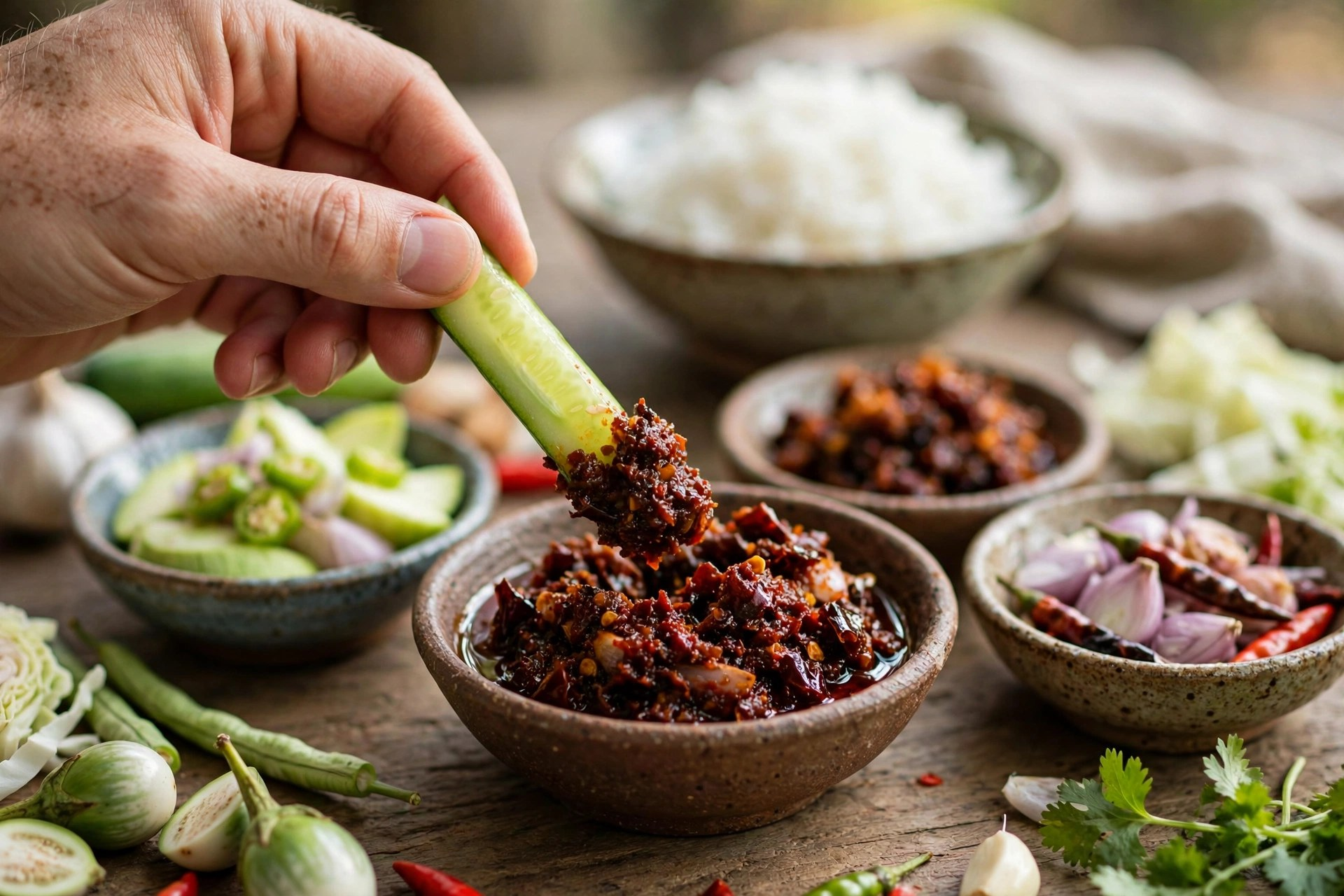
Those vegetables are not garnish. In the south, where the relishes run hottest, the spread of raw cucumber, long beans, cabbage, and Thai eggplant is the cooling counterweight the whole meal is built around — crunch and water and mildness against fire. The relish brings the intensity; the vegetables make it sustainable. It is one of the smartest pieces of food logic in the cuisine.
The dry ones
Not all relishes are wet. Nam phrik narok — the “hell relish” — is a dry, crumbly mixture of dried chilies, shallots, garlic, and dried shrimp, all fried until crisp and ground coarse. It keeps for weeks without refrigeration, which made it the traveler’s relish long before coolers existed, and it is still the one Thai students pack when they go abroad. A spoonful over rice, some vegetables alongside, and you are fed.
At the far edge of the map sit the oddities worth knowing about: nam phrik maeng da, scented with the essence of the giant water bug — a pear-like, almost floral funk that devotees swear by — and the coarse dry powders pounded from toasted chilies and salt that need nothing but rice. The category is bottomless. A Thai food writer once noted, only half joking, that you could spend a lifetime on relishes alone and still not finish.
Where to begin
Start mild and work outward. Nam phrik phao and nam phrik ong are the friendly doors in; a coconut lon is the soft landing after that. Then try kapi, then num, and save the Isan funk and the southern fire for when your confidence — and your rice bowl — is ready.
The technique of eating them is its own subject: the plain rice, the vegetable pairings, the Thai art of folding relish through rice that the Thais call khluk. Our companion guide to eating Thai chili relishes walks through all of it, bite by bite. And if the pounding itself interests you — the granite mortar, the rhythm, the order the ingredients go in — our mortar and pestle guide starts at the beginning.
One honest warning: outside Thailand, relishes almost never make it onto restaurant menus. They are home food, cooked for people who grew up with them, and most Thai restaurants abroad decided long ago that foreigners would not understand. Prove them wrong. Ask at restaurants that cook for Thai expats, look for regional specialists, and order the small fierce bowl in the middle of the table. It is the most Thai thing you can eat.