You’re walking along the beach at night, flashlight in hand, and suddenly you spot dozens of pale, fast-moving crabs darting across the sand. Ghost crabs. They’re everywhere on Atlantic and Gulf Coast beaches, and the thought crosses your mind almost instantly — can you eat these things?
It’s a fair question. After all, we eat blue crabs, Dungeness crabs, king crabs, and snow crabs without thinking twice. So why not ghost crabs? They’re right there, free for the taking, scurrying around your feet like an all-you-can-catch seafood buffet.
The short answer? Technically, yes — ghost crabs are edible. But the real answer is more complicated than a simple yes or no. There are practical, legal, and taste-related reasons why almost nobody actually eats them. Let’s break it all down so you walk away knowing exactly what you’re dealing with.
What Exactly Are Ghost Crabs?
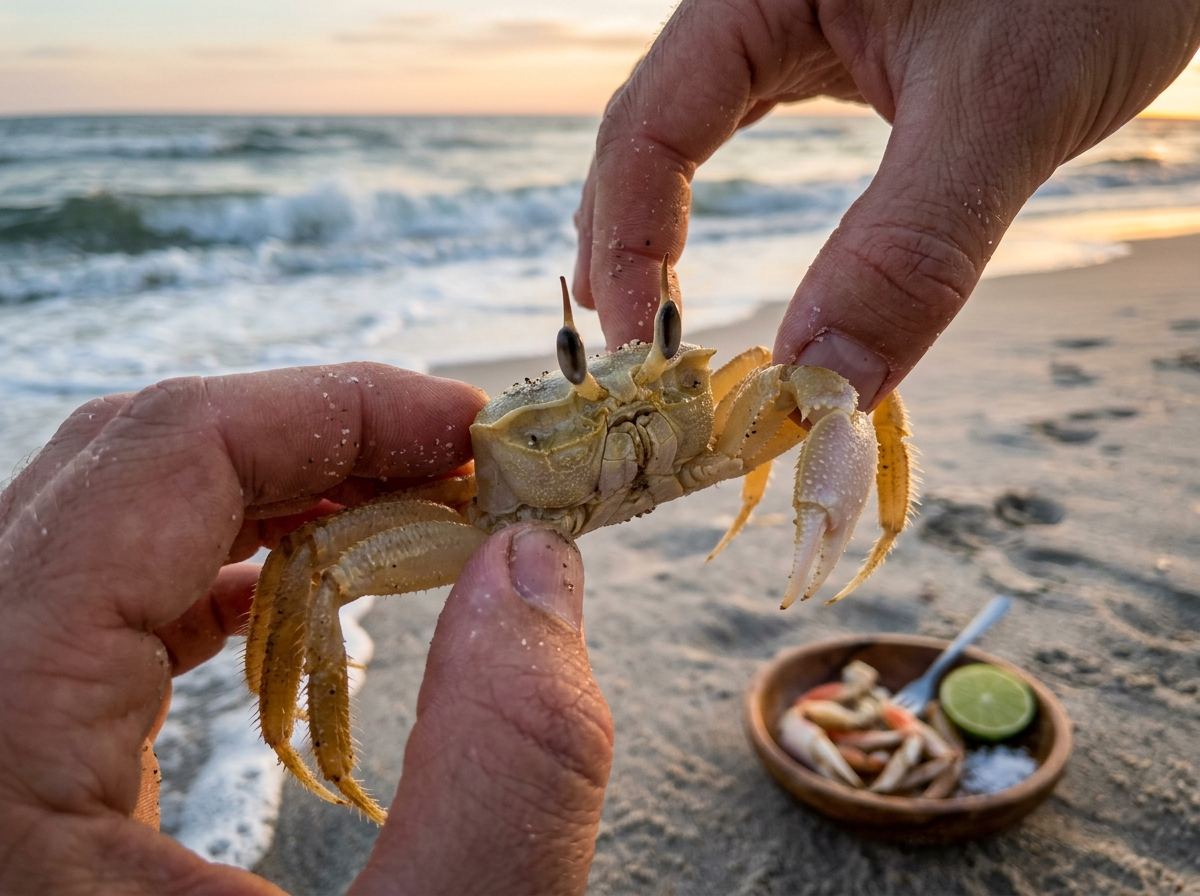
Ghost crabs (Ocypode quadrata) are small, semi-terrestrial crabs found along sandy beaches from Rhode Island all the way down to Brazil. They get their name from their pale, sand-colored bodies and their almost supernatural speed — these little guys can run up to 10 mph, making them one of the fastest crustaceans on land.
They live in burrows dug into the sand, usually above the high-tide line. You’ll rarely see them during the day because they’re mostly nocturnal. At night, though, they come out in huge numbers to feed on sand fleas, clams, turtle eggs, and whatever organic matter the tide washes in.
An adult ghost crab typically measures about 2 to 3 inches across the shell (carapace). Some larger ones can reach close to 3.5 inches, but that’s about the upper limit. Compare that to a blue crab — which averages 5 to 7 inches — and you start to see one of the first problems with eating ghost crabs.
Quick Fact: Ghost crabs can rotate their eyestalks 360 degrees, giving them nearly complete panoramic vision. That’s one reason they’re so hard to catch — they spot you coming from almost any direction.
Are Ghost Crabs Technically Edible?
Yes, ghost crabs are edible in the biological sense. They aren’t poisonous or venomous. They don’t produce toxins that would make you sick. If you caught one, cooked it properly, and ate it, you wouldn’t drop dead.
But “edible” and “worth eating” are two very different things.
Think of it this way — tree bark is technically edible too, but you wouldn’t order it at a restaurant. Ghost crabs fall somewhere in that gray zone. Your body can process the meat, but the experience of eating one leaves a lot to be desired.
The meat inside a ghost crab is safe for human consumption, provided the crab comes from clean, unpolluted waters and sand. The same basic rules that apply to any shellfish apply here: freshness matters, cooking temperature matters, and the environment where the crab lived matters.
⚠️ Warning: Ghost crabs are scavengers. They eat dead fish, decaying organic material, and sometimes even trash left on beaches. If a ghost crab has been feeding in a polluted area near storm drains, sewage outflows, or heavily littered beaches, eating it could expose you to bacteria, parasites, or chemical contaminants. Always consider the source environment before eating any wild-caught food.
Why Most People Don’t Eat Ghost Crabs
So if they’re technically edible, why don’t you see ghost crab on any menu? Why don’t fishermen sell them at seafood markets? There are several very practical reasons.
They’re Tiny — Really Tiny
The biggest obstacle is size. A full-grown ghost crab gives you almost no usable meat. We’re talking about a crab that’s roughly the size of a silver dollar to maybe the size of your palm at most. Once you crack open that thin shell, you’ll find a tiny amount of meat — barely enough to justify the effort.
Compare this to a blue crab or even a small lobster tail, and you’ll understand why nobody bothers. You’d need to catch and clean dozens of ghost crabs just to get a single meaningful serving of crab meat. The effort-to-reward ratio simply doesn’t make sense.
The Taste Isn’t Great
People who have actually tried eating ghost crabs — and yes, there are adventurous folks who’ve done it — generally report that the flavor is underwhelming. The meat tends to be described as bland, slightly gritty, and lacking the sweet, briny richness you’d get from species like Dungeness or king crab.
Some describe a slightly iodine-heavy taste, which makes sense given their diet of sand fleas, decaying organic matter, and whatever they scavenge off the beach. Ghost crabs spend most of their time on land rather than in the ocean, and this terrestrial lifestyle seems to affect the flavor profile of their meat.
The Texture Problem
Beyond taste, there’s a texture issue. Ghost crab shells are thin and brittle, but the meat-to-shell ratio is terrible. You end up with tiny fragments of shell mixed with minuscule bits of meat. It’s not a pleasant eating experience by any standard. Even if you somehow managed to extract clean meat, the texture is more rubbery and fibrous than what you’d expect from ocean-dwelling crab species.
There Are Much Better Options
Let’s be honest — if you’re craving crab, why would you struggle with ghost crabs when so many superior options exist? Blue crabs, snow crabs, king crabs, stone crabs, Dungeness crabs — all of these deliver bigger portions, better flavor, and a much more satisfying eating experience. Even if ghost crabs were abundant and easy to catch, they’d still rank at the very bottom of the crab hierarchy for eating purposes.
If you love seafood and want to try preparing something interesting at home, you’d be much better off learning how to tell when shrimp is perfectly cooked or experimenting with grilling shrimp than chasing ghost crabs down a beach at midnight.
Legal Issues You Need to Know About
Here’s where things get serious. Even if you decided you wanted to eat ghost crabs despite everything mentioned above, you might not legally be allowed to catch them in many places.
Protected Status in Several States
Ghost crabs are protected by law in multiple U.S. states and coastal regions. In states like Virginia, Georgia, and parts of the Carolinas, there are regulations that either prohibit catching ghost crabs entirely or restrict how many you can take. The rules vary by state and even by specific beach or wildlife management area.
Why are they protected? Ghost crabs play an important ecological role. They’re a key part of the beach food chain. Sea birds, raccoons, and other predators depend on them as a food source. They also help process organic debris on beaches, acting as natural recyclers. Removing large numbers of ghost crabs from a beach ecosystem can disrupt the local food web.
Penalties Can Be Real
Getting caught harvesting ghost crabs where it’s prohibited isn’t just a slap on the wrist. Depending on the jurisdiction, you could face fines ranging from $50 to several hundred dollars. In protected wildlife areas or national seashores, the penalties can be even steeper.
Pro Tip: Before you even think about catching ghost crabs — whether for eating or just for fun — check with your state’s Department of Natural Resources or the local wildlife management office. Rules change frequently, and what was legal last year might not be legal this year.
The Ghost Crab Hunting Tradition
Many coastal communities have a tradition of “ghost crab hunting” at night, especially as a family activity with kids. This usually involves flashlights and buckets, and in most cases, people catch-and-release the crabs after observing them. This recreational activity is generally tolerated in most areas, but keeping the crabs — especially in large numbers — is where you run into legal trouble.
What About Nutritional Value?
Let’s assume for a moment that you somehow managed to gather enough ghost crab meat to actually eat a serving. What would you get nutritionally?
Crab meat in general is an excellent source of lean protein, omega-3 fatty acids, vitamin B12, zinc, and selenium. Ghost crab meat would contain similar nutrients, though in much smaller quantities per crab simply because of the size issue.
A typical serving of crab meat (about 3 ounces) provides roughly 15 to 20 grams of protein with very little fat. To get 3 ounces of meat from ghost crabs, you’d likely need somewhere around 20 to 30 individual crabs, depending on size. From a nutritional efficiency standpoint, there are far better ways to get your protein and omega-3s.
If seafood nutrition interests you, something like salmon delivers outstanding health benefits with far less effort. You could bake salmon at 375°F and have a nutrient-packed meal ready in under 20 minutes — no midnight beach chase required.
Could You Eat Ghost Crabs in a Survival Situation?
This is the one scenario where eating ghost crabs actually makes sense. If you’re stranded on a beach with limited food sources, ghost crabs become a legitimate survival food option.
They’re abundant on most sandy beaches along the Atlantic and Gulf coasts. They’re relatively easy to locate at night (just look for their burrows or use any light source). And while each individual crab doesn’t provide much food, catching a couple dozen can give you enough protein and calories to sustain yourself.
How You’d Prepare Them in a Survival Scenario
If you’re in a genuine survival situation and ghost crabs are your food source, here’s the basic approach:
Catch them at night when they’re most active. You can dig them out of their burrows during the day, but nighttime hunting with a light source is far easier since they freeze momentarily when hit with bright light.
Always cook them before eating. Like all wild crustaceans, ghost crabs can carry parasites and bacteria that cooking eliminates. Boiling them for 10 to 15 minutes is the safest method. If you don’t have a pot, you can roast them over an open fire on a flat rock or skewer them on a stick.
Eat the body meat and any roe (eggs) you find. The legs on a ghost crab are too thin and small to bother with individually, but you can crunch through the smaller ones after cooking and extract tiny bits of nutrition.
⚠️ Important: Even in survival situations, avoid eating ghost crabs raw. Raw crustaceans can harbor parasites like lung flukes (Paragonimus species) that can cause serious illness. Take the time to cook them — it’s worth the effort.
This is very different from the debate about eating raw lobster, where certain preparations might be considered. With ghost crabs, there’s no safe raw option worth considering.
Ghost Crabs vs. Other Crabs You Can Actually Eat
To really put things in perspective, let’s compare ghost crabs to some crabs that are actually worth your time and effort in the kitchen.
Blue Crabs are the gold standard for crab eating along the East Coast. They’re larger (5–7 inches), packed with sweet meat, and have an entire culinary tradition built around them. Maryland crab cakes exist for a reason.
Dungeness Crabs from the Pacific Coast can weigh 2 to 3 pounds each and yield a generous amount of tender, slightly sweet meat. One Dungeness crab can feed a person as a main course.
King Crabs from Alaska are the giants of the crab world. A single king crab leg can contain more meat than 50 ghost crabs combined. That’s not an exaggeration.
Stone Crabs from Florida have incredibly flavorful claw meat and are harvested sustainably — fishermen take one claw and return the crab to the water, where it regenerates the claw over time.
Ghost crabs don’t compete with any of these species on any metric — size, flavor, texture, or ease of preparation. They’re fascinating creatures to watch and study, but they simply don’t belong on the dinner plate.
The Ecological Role of Ghost Crabs (Why They Matter)
Understanding why ghost crabs exist beyond being a potential food source helps explain why many coastal areas protect them.
Ghost crabs are what ecologists call a keystone scavenger on sandy beaches. They clean up dead fish, jellyfish, and other organic debris that washes ashore. Without them, beaches would accumulate far more decaying material, which would affect both the ecosystem and the beach experience for humans.
They also serve as a critical food source for shorebirds, including species like sanderlings, plovers, and various gulls. Some of these bird species are themselves threatened or endangered, and losing a major food source would push them closer to the edge.
Ghost crab population density is actually used by marine biologists as an indicator of beach health. A beach with lots of ghost crabs is generally a healthy, well-functioning beach ecosystem. A beach with few ghost crabs might have pollution issues, too much human disturbance, or other environmental problems.
So while you could eat them, removing ghost crabs from their ecosystem has consequences that go well beyond one person’s dinner.
What About Hermit Crabs? Can You Eat Those?
Since we’re talking about crabs that people wonder about eating, you might also be curious about hermit crabs. They’re another species people encounter frequently on beaches and in tide pools. The edibility question comes up just as often, and the answer has similar nuances. If you’re curious, check out our detailed breakdown on whether you can eat hermit crabs — the answer might surprise you.
How to Enjoy Ghost Crabs (Without Eating Them)
If ghost crabs fascinate you — and they should, because they’re genuinely interesting creatures — there are better ways to enjoy them than trying to eat them.
Nighttime ghost crab watching is a popular activity on beaches from the Carolinas down to Florida and along the Gulf Coast. All you need is a flashlight (a red-filtered light is best, as it disturbs them less) and some patience. Head to the beach about an hour after sunset, and you’ll start seeing them emerge from their burrows.
Watch how they communicate — ghost crabs make sounds by stridulating, which means they rub body parts together to create rasping noises. Males do this to establish territory and attract mates. It’s one of the few sounds crabs make that you can actually hear without special equipment.
If you have kids, ghost crab watching is an incredible educational experience. Children love the excitement of spotting them, and it’s a perfect opportunity to teach about marine biology, ecosystems, and conservation in a hands-on way.
FAQ
Is it illegal to catch ghost crabs?
It depends entirely on where you are. Several U.S. states have laws protecting ghost crabs, and many beaches within national or state parks prohibit collecting any wildlife, including ghost crabs. Always check local regulations with your state’s wildlife management agency before catching ghost crabs. Penalties for violations can include fines of $50 to several hundred dollars.
Do ghost crabs taste like regular crab?
Not really. People who have tried ghost crab meat describe it as bland, slightly gritty, and lacking the sweet, buttery flavor of species like blue crab or Dungeness crab. The taste is often described as mildly iodine-flavored, which relates to their scavenger diet on land. If you’re craving crab, you’ll be much happier with commercially available crab species.
Can ghost crabs make you sick?
Ghost crabs themselves aren’t toxic or poisonous, but they can potentially make you sick if eaten raw or if they come from polluted environments. Like all wild crustaceans, they can carry parasites and bacteria. Cooking ghost crabs thoroughly — boiling for at least 10 to 15 minutes — eliminates most risks. The bigger concern is environmental contamination; ghost crabs from beaches near sewage outflows, storm drains, or industrial areas may have accumulated harmful substances.
How many ghost crabs would you need to make a meal?
Because ghost crabs are so small (2 to 3 inches across), you’d need roughly 20 to 30 crabs to get enough meat for a single modest serving. Each crab yields a very tiny amount of meat, making them highly impractical as a food source outside of a genuine survival situation.
Are ghost crabs endangered?
Ghost crabs are not currently classified as endangered or threatened at the species level. Their populations are generally stable across most of their range. They are, however, protected by various state and local regulations because of their ecological importance and because some local populations can be vulnerable to habitat disruption from beach development, artificial lighting, and heavy foot traffic.
Final Thoughts
Ghost crabs are one of those animals that spark genuine curiosity. You see them darting across the sand, and your brain immediately asks the question — can I eat that? The answer is yes, you technically can, but you almost certainly shouldn’t.
They’re too small, the meat isn’t flavorful, collecting them may be illegal where you live, and there are dozens of better seafood options available. From a practical standpoint, you’d spend more energy catching and cleaning ghost crabs than you’d ever get back in calories or enjoyment.
The one exception is a true survival situation, where ghost crabs become a viable, protein-rich food source that’s relatively easy to catch at night on any sandy beach.
For everything else? Enjoy ghost crabs for what they really are — fascinating, lightning-fast creatures that make beach nights more interesting. And when you’re actually hungry for seafood, put your energy toward something that delivers real satisfaction. A beautifully grilled salmon or a plate of perfectly seasoned shrimp will always beat a pile of tiny ghost crabs — no contest.