Two extra minutes can turn salmon from juicy to dry at 425°F. That’s why so many people search this and still end up guessing. If you want to bake salmon at 425 and get a moist center with lightly crisp edges, timing matters more than any fancy marinade. Most fillets are done in about 10 to 12 minutes, but thickness, skin, and your pan can shift that window. Once you know what to look for, salmon gets a whole lot easier.
Here’s the short answer most people want right away: salmon usually bakes at 425°F for 8 to 14 minutes, depending on thickness.
A thin fillet cooks fast. A thick center-cut piece needs more time. A whole side of salmon can take closer to 14 to 18 minutes. That’s why one person says “mine was done in 9 minutes” and another swears it needed 15. They’re both probably right.
Quick answer:
For 1-inch thick salmon fillets, start checking at 10 minutes. Most will be ready by 10 to 12 minutes.
| Salmon thickness or cut | Usual bake time at 425°F |
|---|---|
| 1/2 inch thin fillet | 6–8 minutes |
| 3/4 inch fillet | 8–10 minutes |
| 1 inch fillet | 10–12 minutes |
| 1 1/4 to 1 1/2 inch fillet | 12–14 minutes |
| Whole side of salmon | 14–18 minutes |
Quick fact: Thickness matters more than weight.
A flat 1-pound salmon side and two chunky 8-ounce fillets won’t cook the same way.
If you only remember one thing from this article, make it this: start checking early. Salmon doesn’t give you a lot of warning before it goes from tender to dry.
Why 425°F works so well for salmon
Think of 425°F as a sweet spot for weeknight cooking. It’s hot enough to cook salmon fast, brown the edges a little, and help the skin crisp up. At the same time, it’s not so aggressive that you need chef-level reflexes.
That balance is why so many home cooks like it.
At lower oven temperatures, salmon cooks more gently. You get a bit more room for error, but you also wait longer. If you want to compare methods, these guides for bake salmon at 400 and bake salmon at 375 show how the timing changes.
There are a few times when 425°F isn’t the best choice.
Very thin tail pieces can dry out before the thicker parts finish. A heavy honey or brown sugar glaze can darken too fast. And if you want a very soft, almost poached texture, a lower temperature may suit you better.
Still, for most fillets? 425°F does the job really well.
Warning: Sweet glazes burn faster at 425°F. Add them near the end, not at the start.
How to bake salmon at 425 step by step
You don’t need a complicated recipe here. A simple method works best because salmon already has plenty of flavor.
Start with the right salmon
Center-cut fillets are the easiest to cook evenly. They’re thicker and more uniform, so you don’t get a dry tail on one end and undercooked fish on the other.
Skin-on fillets are also forgiving. The skin protects the bottom from direct heat and makes it easier to move the fish after baking.
Atlantic salmon is fattier, so it stays moist a little more easily. Wild salmon like sockeye is leaner, which means it can cook faster and dry out sooner if you push the time.
Frozen salmon is okay, but thawed salmon gives you more even results. If your fish is still solid from the freezer, use a safe thawing method first. This guide on thawed salmon in the fridge can help.
Season and prep the pan
Line a sheet pan or baking dish with parchment paper or foil. That cuts down on sticking and cleanup.
Pat the salmon dry with paper towels. Don’t rinse it. Dry fish roasts better, and your seasoning sticks more evenly.
Now add a light layer of oil. Olive oil works well. Then season with kosher salt, black pepper, and anything else you like. Lemon slices, garlic, paprika, dill, parsley, and a little melted butter all play nicely with salmon.
If you want more flavor than the basic salt-and-pepper route, these ideas for salmon rub options are worth a look.
Pro tip: Fold a thin tail section under itself. That helps the whole fillet cook at a more even pace.
Bake, rest, and serve
Here’s the simple method I’d use at home:
- Heat your oven to 425°F.
- Place the salmon on the pan skin side down.
- Bake for 8 minutes, then start checking.
- Keep baking until the fish flakes easily at the edges and the center reaches your target doneness.
- Let it rest for 3 to 5 minutes before serving.
That’s it.
For a normal 1-inch fillet, you’ll usually land around 10 to 12 minutes. Thick pieces may need 13 or 14. A whole side of salmon often needs 14 to 18 minutes, depending on the thickest part.
If you’re using a glaze, brush it on during the last 3 to 4 minutes so it gets shiny without turning bitter.
A squeeze of lemon at the end wakes everything up. Fresh herbs do too. You can also add a little butter while it rests if you want a richer finish.
How to tell when salmon is done
This is where most people get stuck. Time gives you a good estimate, but doneness is what matters.
Use a thermometer first
The easiest way to avoid dry salmon is an instant-read thermometer.
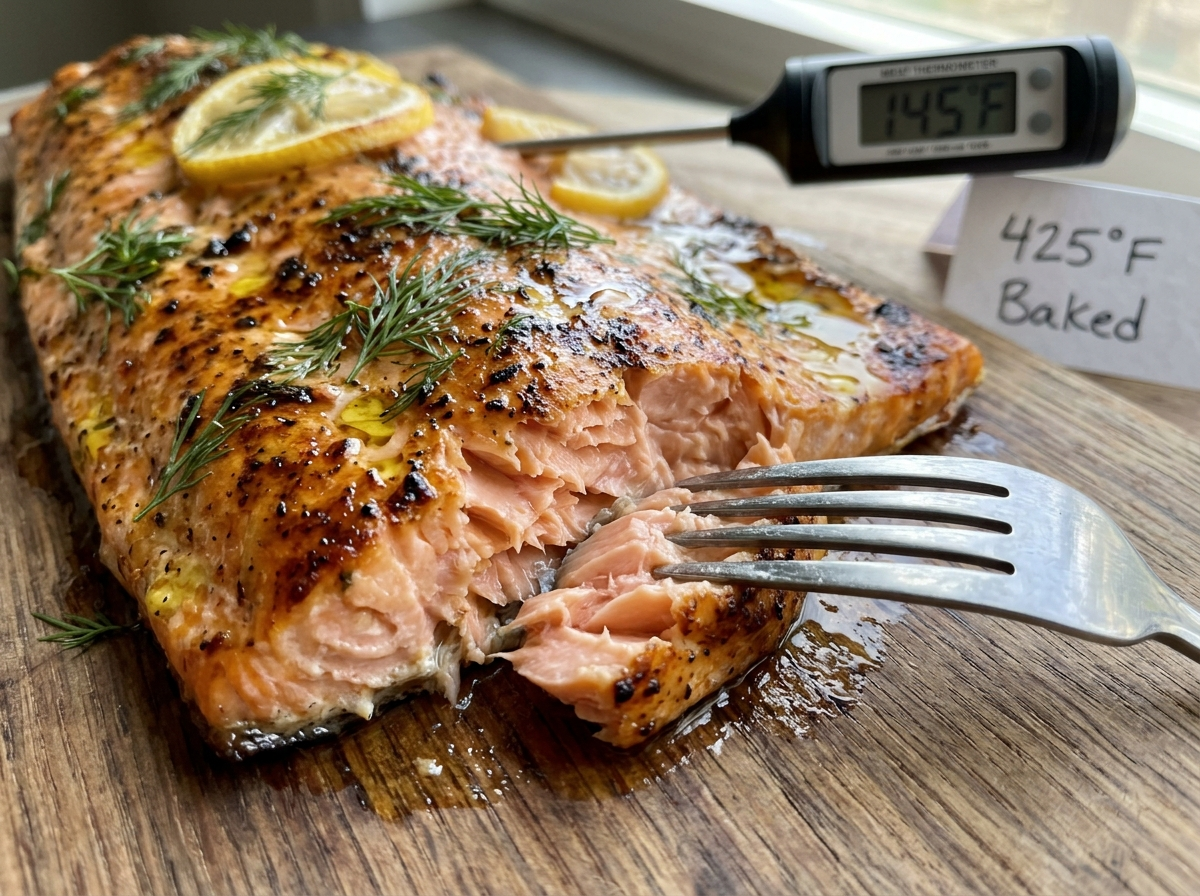
Insert it into the thickest part of the fillet. As of 2026, USDA food safety guidance for fish still uses 145°F as the safe internal temperature.
A lot of cooks pull salmon earlier, around 125°F to 135°F, because the texture stays softer and carryover heat keeps it cooking as it rests. That’s common in home kitchens and restaurants, but it’s a texture choice, not the USDA safety target.
Food safety note: If you’re cooking for pregnant guests, older adults, young kids, or anyone with a weakened immune system, stick with 145°F.
Carryover cooking is real here. Once salmon comes out of a hot oven, the center can rise another 3 to 5 degrees while it rests. So if your goal is a juicy medium finish, don’t wait until it looks fully finished in the oven.
Check the visual signs
No thermometer nearby? You can still check salmon with your eyes and a fork.
Look for these signs:
- The flesh turns more opaque as it cooks.
- The edges start to flake with light pressure.
- The center separates easily but still looks slightly moist.
- The fish stops looking raw and glossy in the middle.
If you press a fork into the thickest part and it opens into soft flakes, you’re close.
You may also notice a white substance on top. That’s albumin, a protein that comes out as salmon cooks. It looks odd, but it’s harmless. Usually, you’ll see more of it when the fish cooks a little too hot or a little too long.
Did you know? The white stuff on baked salmon isn’t fat or spoilage. It’s just coagulated protein.
If you want a more detailed breakdown of visual doneness signs, this page on how to know when salmon is done is useful.
What changes the bake time at 425
This is the part a lot of articles skip. They give one number, and that number doesn’t work for everyone. Your salmon may need more or less time for very normal reasons.
Thickness beats total weight
A thick fillet always takes longer than a thin one, even if they weigh about the same.
Picture two salmon pieces. One is wide and flat. The other is tall and chunky. The chunky one may need several extra minutes because heat has farther to travel to the center.
That’s why “how long per pound” isn’t the best way to think about salmon. For fish fillets, shape matters more than pounds.
The type of salmon matters too
Farmed Atlantic salmon usually has more fat. That makes it more forgiving in the oven.
Wild salmon, especially sockeye, is leaner. It can go from perfect to overdone faster. If you’re baking wild salmon at 425°F, start checking a little sooner than you would with Atlantic.
King salmon is rich and thick, so it may need longer than sockeye even if the pieces look similar at a glance.
Your pan changes the result
A metal sheet pan cooks faster than a glass dish. Dark pans brown the bottom more quickly than light pans. Parchment paper softens the heat a bit compared with bare metal.
If your oven runs hot, your salmon may finish earlier than the timing chart suggests. Home ovens are famous for being off by 10 or 15 degrees. If salmon always seems to overcook in your kitchen, the oven may be the reason, not you.
Covered salmon cooks differently
Should you cover salmon? Only if you want a softer, steamier result.
An uncovered fillet roasts. A covered fillet steams more. Both can taste good, but the texture changes.
At 425°F, I’d keep salmon uncovered if you want a slightly roasted top and better color. Cover it loosely only if the surface is browning too fast or if you’re cooking from frozen and want to protect the outside at the start.
Foil packets and parchment packets add steam
Salmon baked in a foil packet often needs a little more time because steam builds around the fish. The upside is moisture. The downside is less browning.
If you love a buttery, soft texture with lemon and herbs, packets are great. If you want crisp edges, use an open sheet pan.
Glazes can speed up browning
Soy sauce, maple syrup, honey, teriyaki, and brown sugar can make salmon look done before the center actually is.
That dark top can fool you. Always check the thickest part.
If you’re planning bold flavors, brush sauces on near the end. That keeps the outside from getting too dark at 425°F.
Real timing examples
A few quick examples make this easier:
A 6-ounce Atlantic salmon fillet, about 1 inch thick, usually bakes at 425°F for 10 to 12 minutes.
A thin wild sockeye fillet, closer to 3/4 inch, may be ready in 8 to 10 minutes.
A thick king salmon fillet, around 1 1/4 inches, can take 12 to 14 minutes.
A whole side of salmon with a thick center often lands around 14 to 18 minutes.
See why timing advice online can feel all over the place? People aren’t always using the same cut.
Common mistakes, leftovers, and reheating
A few small mistakes cause most dry salmon problems. The good news is they’re easy to fix.
Mistakes that dry out salmon
The biggest mistake is trusting the clock more than the fish.
Ovens vary. Pans vary. Fillets vary. Use the timing chart as a starting point, then check the salmon itself.
Another common issue is leaving the fish in until it looks fully finished. Because of carryover cooking, salmon keeps going after you pull it out. If it looks perfect in the oven, it may be slightly over by the time it hits the plate.
Over-seasoning with sugary sauces at the start can also cause trouble. The top browns too quickly, and you end up guessing about the center.
Crowding the pan doesn’t help either. Give the fillets a little space so heat can move around them.
One more thing people miss: the thin tail end cooks much faster than the thick center. Fold it under, or it may dry out while you wait for the middle to finish.
How to store and reheat baked salmon
If you have leftovers, get them into the fridge within 2 hours.
Store baked salmon in a sealed container and use it within 3 to 4 days. If you want the full storage breakdown, here’s a guide to cooked salmon in the fridge.
For reheating, low and slow works best. A 275°F oven for about 10 to 15 minutes helps keep the fish from drying out. A microwave works too, but use short bursts and stop as soon as it’s warm.
Cold leftover salmon is great in salads, rice bowls, sandwiches, or tucked into wraps, so you don’t always need to reheat it at all.
- FAQ Section
FAQ about baking salmon at 425
How long do you bake salmon at 425 per pound?
For salmon, don’t rely on pounds alone. Thickness is a better guide than weight. Most 1-inch thick fillets bake at 425°F in about 10 to 12 minutes, while a whole side of salmon often takes 14 to 18 minutes.
Should salmon be covered or uncovered at 425°F?
Most of the time, bake salmon uncovered at 425°F. That gives you better color and a lightly roasted texture. Cover it only if the top is browning too quickly or if you want a softer, steamier finish.
Is 425 too hot for salmon?
No, 425°F is not too hot for salmon. It’s a solid oven temperature for fillets because it cooks them fast and can keep the inside moist if you don’t overbake. The key is checking early, especially with thin or lean pieces.
Can you bake frozen salmon at 425?
Yes, you can. Frozen salmon usually needs about 4 to 6 extra minutes, though the exact time depends on thickness. For the most even result, thaw it in the fridge first, then bake as usual.
Do you bake salmon skin side down or up?
Bake salmon skin side down. The skin acts like a barrier between the fish and the hot pan, which helps protect the flesh and makes serving easier. If you want crispy skin, you can finish it under the broiler for a minute, but watch it closely.
- Conclusion
If you’re making salmon tonight, keep it simple: set the oven to 425°F, start checking around 8 to 10 minutes, and trust the thickness of the fish more than the timer. A quick temp check, a short rest, and a little patience will do more for your salmon than any complicated trick. Try it once with a 1-inch fillet, and you’ll stop guessing from then on.