The difference between perfectly cooked salmon and a dry, chalky disaster? Often less than 10°F. That’s it. Just a few degrees separate buttery, melt-in-your-mouth fish from something that tastes like it went through a drought.
If you’ve ever stood over a pan or peeked into the oven wondering, “Is this done yet?” — you’re not alone. It can be tough to know when salmon is perfectly cooked because its texture and color change gradually — and for that reason, it’s fairly easy to overcook or undercook it. But here’s the good news: once you learn a few simple cues, you’ll never have to guess again.
This guide covers every reliable method — from thermometer readings to visual tricks that professional chefs use on the line — so you can cook salmon with confidence, whether you’re baking, grilling, pan-searing, or poaching.
Why Getting Salmon Doneness Right Actually Matters
You might think a minute or two either way doesn’t matter much. With chicken or beef, you’d be right — they’re more forgiving. But salmon? Not so much.
Overcooking salmon dries it out, while undercooking can leave it raw (and cold) in the center, which affects both how it tastes and whether or not it’s safe to eat. You end up with either cardboard-textured fish or something that makes your guests uncomfortable.
Salmon that’s cooked properly should be tender, moist, and almost silky. Salmon that’s dry because it’s been overcooked is much less appealing to most palates.
The thing most people don’t realize? Salmon keeps cooking even after you pull it off the heat. Because the residual heat will continue to cook your salmon even after removing it from the burner or oven, you should take that into consideration. That’s why knowing the right moment to stop cooking is everything.
The Thermometer Method: Your Most Reliable Friend
Let’s start with the most accurate approach. If you own an instant-read thermometer (and honestly, you should), checking doneness takes about three seconds.
The best way to check the internal temperature of salmon is with a meat thermometer. Simply insert the thermometer into the thickest part of the salmon. Not the thin tail end — that’ll give you a false reading. Always go for the fattest section of the fillet.
Now, here’s where things get interesting. The US Department of Agriculture recommends salmon and other fish products be cooked to an internal temperature of 145°F. That’s the official “safe” number. But ask any chef, and they’ll tell you a different story.
At 145 degrees, salmon can be overcooked, dry, and tough. When conducting taste tests, America’s Test Kitchen’s test cooks and taste testers agreed that the ideal internal temperature for farmed Atlantic salmon is just 125 degrees, at which point its flesh turns firm yet silky.
So what temperature should you actually aim for? That depends on your preference.
Quick Temperature Reference:
- Rare (120°F): Deep pink flesh at the center, with a seared exterior. Only for sushi-grade fish.
- Medium-Rare (125°F): A pink center with a fully cooked exterior and skin. Tender and buttery.
- Medium (130°F): A very light pink center with a fully cooked exterior. This is the sweet spot for most home cooks.
- Medium-Well (135–140°F): Flakey and firm, with almost no pink color at the center.
- Well-Done (145°F+): The salmon can be dry, chewy and chalky. The USDA’s recommendation, but not most chefs’ first choice.
Pro Tip: Pull your salmon off the heat about 5°F before your target temperature. Pull salmon off the heat or out of the oven just before it reaches full doneness. Cover and let it rest for about 10 minutes. During this time, residual heat will continue to cook the meat and the internal temperature in the center will continue to rise even after it is off the heat.
If you’re cooking salmon for children, elderly family members, or anyone with a compromised immune system, prioritize temperature verification and stick to the USDA’s 145°F guideline.
The Fork Flake Test: How Chefs Check Without a Thermometer
Don’t have a thermometer handy? No problem. The fork flake test is the technique most professional cooks rely on when they’re working the line and don’t have time to grab a gadget.
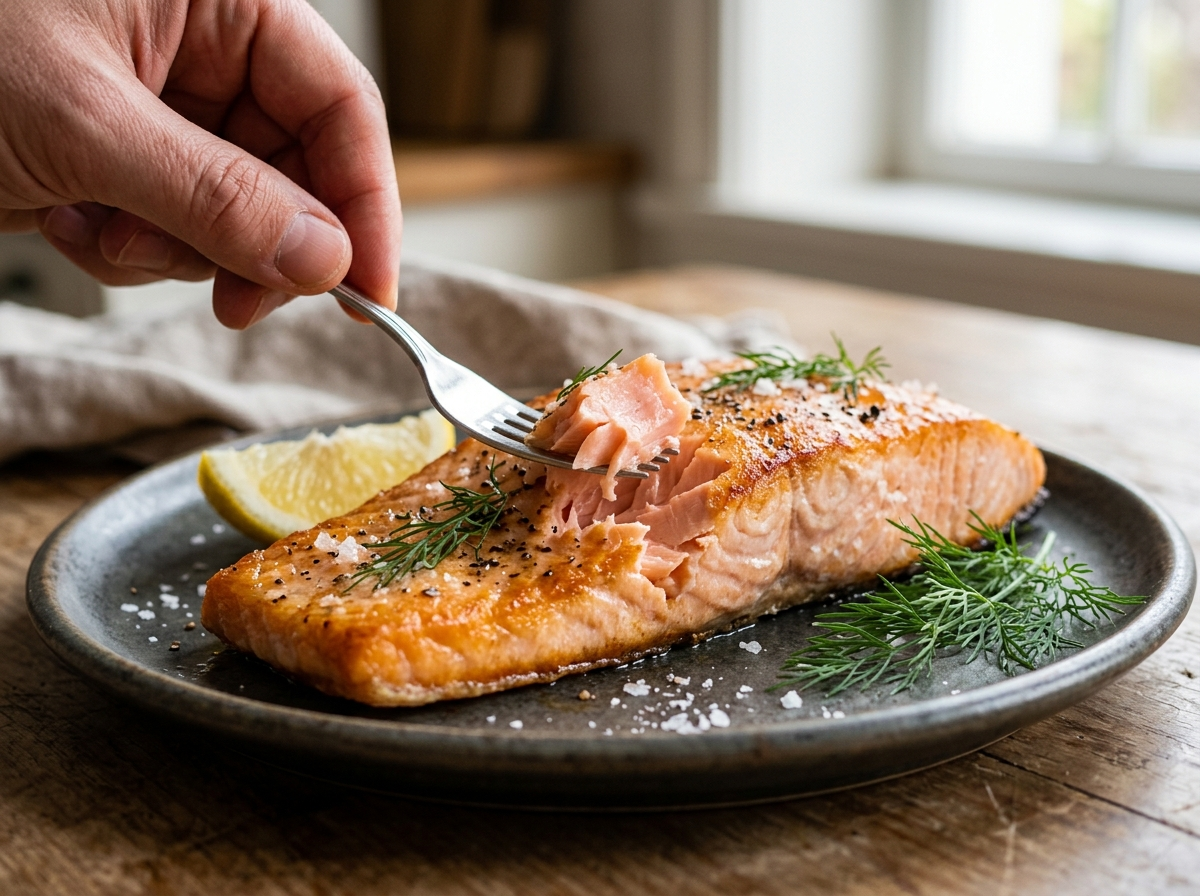
Here’s how it works: Insert a fork into the thickest part at an angle and twist gently. If the flesh separates into large flakes but still feels moist, it’s ready. If it resists, continue cooking.
That word “large” is important. Properly done salmon should flake in large, clean layers when nudged with a fork. If it crumbles or feels mushy, it’s likely overcooked. Slight resistance followed by separation is ideal.
Think of it like a good book — the pages should turn easily, but they shouldn’t be falling out of the binding.
Reading the Color: What Your Salmon Is Telling You
Your eyes can give you surprisingly reliable information if you know what to look for. Salmon goes through a very visible color transformation as it cooks.
When it’s raw, it is red-orange and translucent; as it nears doneness, it will turn pink and become opaque. That shift from glossy and translucent to matte and opaque is your biggest visual clue.
Here’s a chef-approved trick from Food Network star Geoffrey Zakarian: Watch and wait for the deep red salmon to turn an opaque, pale pink most of the way up the side of the fish, which will take anywhere from 8 to 10 minutes. Flip the fish over and remove the salmon when it’s pale pink on the sides. There you have it, perfectly cooked salmon!
You can literally watch the color creep up the sides of your fillet as it cooks. Once the flesh turns from translucent to opaque all the way up the sides and starts to creep onto the top, turn off the heat.
Keep in mind that the color and appearance for wild versus farmed salmon may differ when they are fully cooked. Farmed salmon tends to be lighter and more orange-pink, while wild salmon runs deeper red. Both should shift from translucent to opaque — the color itself just varies.
Did You Know? If the meat is beginning to flake, but still has a little translucency in the middle, it is done. It should not, however, look raw. A hint of translucency in the center is actually the mark of perfectly cooked salmon — not a sign that it needs more time.
The Touch Test: Feel Your Way to Perfect Salmon
This one takes a bit of practice, but once you get it, you’ll feel like a pro. Light pressure should produce gentle spring-back, not mushiness. Raw salmon feels soft; done salmon feels firm but not stiff.
Press the top lightly. It should spring back slightly but leave a faint indentation — similar to medium-rare steak. If it feels hard and unyielding, you’ve gone too far. If it feels like poking a water balloon, it needs more time.
Two More Tricks Worth Knowing
The Skewer Test
This one comes from professional kitchens and it’s clever. Use the “Skewer Test.” If you can push the flat end of a wooden skewer through the thickest part of the salmon with no resistance, it is finished cooking.
The Butter Knife Method
After roughly 6 minutes of cooking, quickly insert a butter knife into the thickest part of the fillet — remove it and touch the knife to your bottom lip. If the knife feels lukewarm then it still needs a bit more cooking. The temperature you are looking for is medium warm. This method does take a little practice, but it’s quite reliable.
Your bottom lip is extremely sensitive to temperature, making it a surprisingly accurate tool. Old-school French chefs have been using this trick for decades.
Wild vs. Farmed: They Don’t Cook the Same Way
This is something that trips up a lot of home cooks, and most online recipes don’t even mention it.
Wild salmon cooks faster than farmed. In the time it takes to cook a fillet of farm-raised salmon to a tender medium rare, a wild fillet will dry out and have lost much of its depth of flavor and luscious texture. The reason why wild salmon cooks faster than farmed is simple: wild salmon is a leaner fish.
How much leaner? Farmed salmon has about 15 grams of fat per 113-gram serving, while wild salmon has about 5 grams. That’s three times more fat in farmed salmon — and fat acts as insulation during cooking.
What this means in practical terms:
The ideal internal temperature for farmed Atlantic salmon is just 125 degrees, at which point its flesh turns firm yet silky. And when you cook with wild varieties, pull the fish off the heat even sooner, when its internal temperature reaches 120 degrees.
If you blindly follow some fish recipes on the internet, you’ll learn the hard way that you can easily overcook wild salmon. That’s because many cooked salmon temperatures and times are designed around farmed salmon. So always check the label before you start cooking — it’ll change how you approach the whole process.
If you’re grilling your salmon, having the right temperature setup matters just as much as knowing when to pull it. Check out our guide on the best temperature to grill salmon for exact grill settings and timing.
That White Stuff on Your Salmon? Here’s What It Is
You’ve seen it. That white, slightly creepy-looking substance that oozes out of your salmon while it cooks. Before you panic — it’s completely normal.
This white stuff on salmon is a protein known as albumin. Albumin is a flavorless, moisture-rich protein that collects on the surface of salmon as it cooks. It is completely natural and a normal part of the salmon cooking process. Albumin is safe to eat.
When you cook a piece of salmon, the muscles contract, squeezing the semi-solid substance onto the surface of your fish, where it congeals. The higher the heat and the longer you cook, the more albumin you’ll see.
So how do you reduce it? A few easy methods:
One of the most effective methods to prevent albumin from appearing is brining your salmon before cooking. A proper brine can significantly reduce the white stuff while enhancing flavor and moisture. Give your salmon a quick soak in a blend of sea salt and water — one tablespoon of salt per cup of water for 10 minutes — which will help relax and dissolve the muscle fibers and minimize the appearance of albumin.
You can also cook salmon slowly over low heat. If you are searing it or grilling salmon over high heat, just make sure you cook the salmon skin-side down for most of the time. The skin acts as an insulator and cooks the salmon more gently.
And here’s a reassuring thought: When albumin shows up on the flesh of your salmon, it typically means that the fish has lost some moisture. So if you’re seeing a lot of it, that’s your fish telling you it’s probably been cooking a bit too long or at too high a temperature. It’s a built-in doneness indicator, if you think about it.
Doneness Cues by Cooking Method
Not all cooking methods give you the same visual signals. Here’s what to watch for based on how you’re preparing your salmon.
Baking
Baking remains the most forgiving method for beginners. It provides consistent heat and allows easy visual monitoring. If you’re baking salmon at 375°F, expect roughly 12–15 minutes for a standard fillet. If you prefer a hotter oven, our guides to baking salmon at 400°F and baking salmon at 425°F break down exact timings.
The color creep technique works really well here — watch the sides of the fillet turn opaque from bottom to top.
Pan-Searing
Pan-seared salmon gets crispy edges but stays pink inside. Start skin-side down, and use the color shift up the sides as your primary visual guide. Most of the cooking should happen on the skin side — flip for just 1–2 minutes at the end.
Grilling
Grill marks hide surface cues, so always flake-test the thickest part. The charred exterior can make it tough to read the color accurately, so the fork test or a thermometer becomes extra important here. You might also find our guide to perfectly grilling shrimp helpful if you’re doing a seafood spread.
Steaming and Poaching
Place the salmon on a heatproof plate or in a bamboo steamer, cover it up and steam it for 8–10 minutes. You’ll know it’s done when it turns opaque and flakes easily with a fork. Poached salmon stays jewel-toned but needs careful timing.
The Importance of Resting Your Salmon
This is the step most people skip — and it’s costing them perfectly cooked fish.
The resting time after cooking is an essential step to redistribute the heat and moisture of the salmon meat. Once the target temperature for the desired level of doneness is reached, allow the cooked salmon meat to rest for about 3–5 minutes.
During rest, the juices are distributed throughout the meat and the cooking process continues slightly. Cut into your salmon the second it leaves the pan, and you’ll lose all those beautiful juices onto the plate. Give it a few minutes under a loose tent of foil, and you’ll be rewarded with a fillet that’s evenly moist from edge to center.
Pro Tip: If you’ve nailed your salmon and want to know how long the leftovers will stay good, check out our guide on how long cooked salmon lasts in the fridge. And if you’re working with defrosted fish, here’s everything you need to know about thawed salmon storage.
Common Mistakes That Lead to Overcooked (or Undercooked) Salmon
Not accounting for carryover cooking. If you’re unsure, pull it a minute early. You can always return it to the heat — you can’t undo overcooked fish. This is the single most important principle in salmon cooking.
Relying only on time. Cooking times vary widely based on thickness, starting temperature, and method. A recipe that says “cook for 12 minutes” is a rough estimate, not a guarantee. Your fillet might be thicker, colder, or a different species than the one used in the recipe.
Ignoring thickness. Thicker steaks need lower heat and longer time. A thin tail piece and a thick center cut don’t cook at the same rate. If your fillet varies in thickness, consider folding the thinner end underneath to create a more even shape.
Cooking from frozen without thawing properly. If you’re using frozen salmon, ensure it’s fully thawed before cooking. Uneven thawing leads to inconsistent doneness. Cooking salmon that hasn’t been properly tempered can cause uneven fiber contraction and increased albumin production.
Opening the oven too often. Testing too early — opening oven or grill frequently — lowers temperature and delays cooking. Set a timer, trust the process, and check only when you’re close to the estimated time.
FAQ
What temperature should salmon be cooked to?
The US Department of Agriculture recommends salmon and other fish products be cooked to an internal temperature of 145°F. That said, at 135 degrees the salmon will be silky, tender and safe to eat. At 125 degrees, the salmon will be tender and moist — you’ll be able to cut it easily with a fork, and it won’t flake or fall apart as easily as at a higher temp. If you prefer a firm but not dried-out slice of salmon, use 125 degrees to 135 degrees as your best salmon internal temp.
How do you know if salmon is done without a thermometer?
Use the fork test (flakes separate cleanly), check opacity (no glossy red center), and press gently (yields slightly, then rebounds). The combination of these three checks — flakiness, color, and firmness — gives you a reliable picture of doneness even without any tools. You can also try the butter knife lip test described above. For more seafood doneness tips, see our guide on how to tell when shrimp is cooked.
Is slightly pink salmon safe to eat?
Yes. Many chefs and home cooks prefer medium-rare (110–125°F) for its buttery texture. It’s safe if handled properly and consumed promptly. The pink center isn’t a sign of rawness — it’s a sign of perfectly tender salmon, assuming the fish was fresh and properly stored. Just remember that food safety guidelines from the USDA do suggest reaching 145°F for maximum safety, especially for vulnerable populations.
What does overcooked salmon look like?
Overcooked salmon dries out and turns pale. It should never be rubbery, mushy, or completely chalky white. If your salmon is falling apart into tiny pieces rather than separating into clean flakes, that’s another sign it went too far.
Should I cook wild salmon differently than farmed?
Absolutely. It comes down to one main difference: Wild-caught salmon tends to be leaner than farm-raised, meaning it’ll overcook much more easily. In general, you want to cook wild-caught salmon to 120 degrees Fahrenheit and farm-raised to 125 degrees Fahrenheit. Knowing which type you’re working with before you turn on the stove can save your dinner.
Your Salmon, Your Rules
Here’s what it comes down to: there’s no single “right” answer for when salmon is done. The USDA says 145°F. Most chefs say 125°F. Your preference might be somewhere in between.
The best approach? Use more than one check. Combining two methods (e.g., flake test + brief temp check) balances speed and accuracy. Start with visual cues, confirm with a fork, and if you want total confidence, grab that thermometer. After a few tries, you’ll develop a feel for it — and that’s when cooking salmon stops being stressful and starts being fun.
Your next step: pick up a fillet tonight, try the color-creep technique or the fork test, and see how it feels. And if you’re storing any leftover fish, here’s a helpful reference on how long cooked shrimp lasts — because good seafood habits go beyond just salmon.