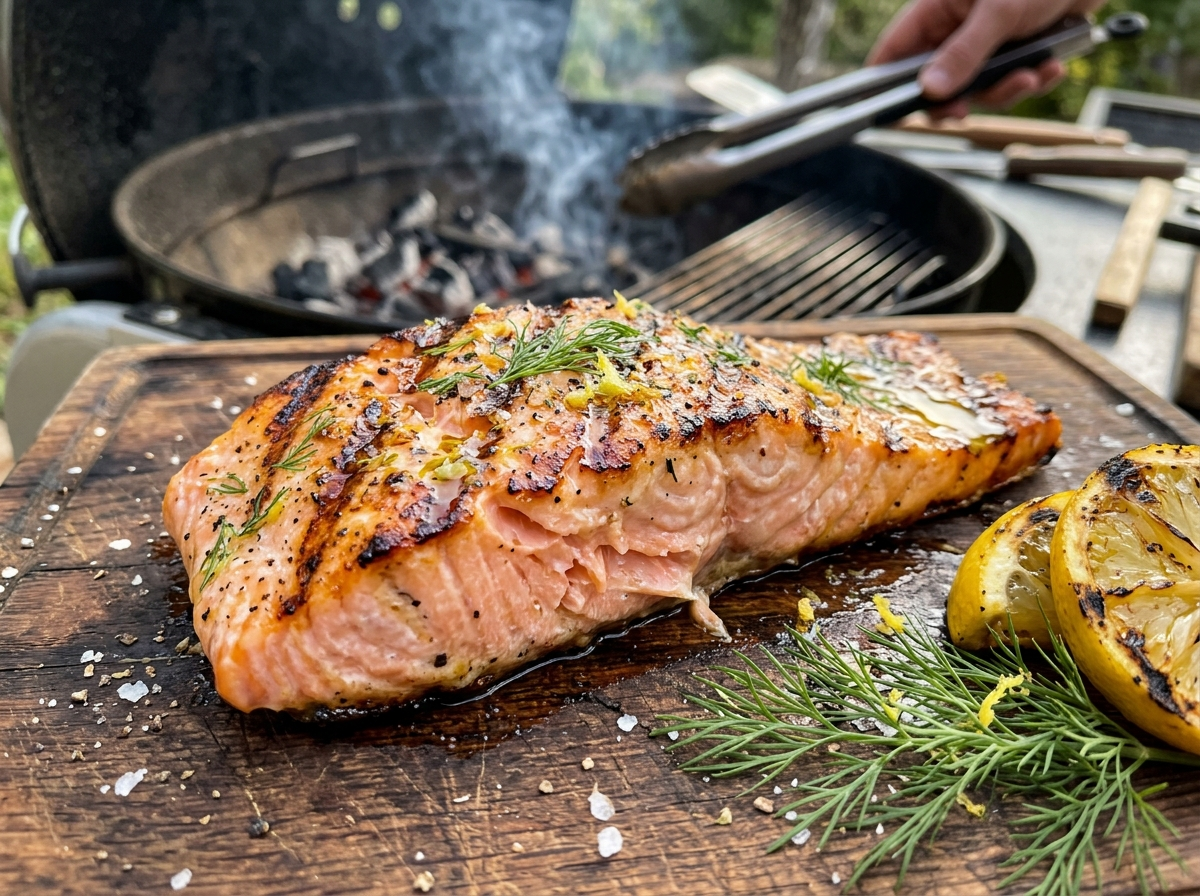
Salmon can go from juicy to dry faster than most people expect. That’s why so many grilled fillets look great on the outside but turn chalky in the middle. The best temp to grill salmon for most home cooks is around 400°F. It’s hot enough to crisp the skin and give you color, but not so hot that the fish dries out before the center is ready. The real win comes from pairing that grill temp with the right internal temperature.
Best temp to grill salmon: the short answer
If you want the simple answer first, here it is: set your grill to about 400°F (204°C).
That’s the sweet spot for most salmon fillets. It works well on a gas grill, charcoal grill, and even a pellet grill running in grill mode. At 400°F, the outside cooks with nice color, the skin can crisp up, and the inside still has time to stay tender.
You don’t need to chase one magic number with zero flexibility, though. A good working range is 375°F to 425°F. Inside that range, 400°F is the easiest place to start.
Quick Facts
- Best grill temperature for most salmon: 400°F
- Good working range: 375°F to 425°F
- Best pull temp for moist salmon: 125°F to 130°F
- Conservative food-safety target for fish: 145°F
- Typical time for a 1-inch fillet: 7 to 10 minutes total
A lot of confusion happens because people mix up grill temperature and salmon internal temperature.
Those are not the same thing.
Your grill might sit at 400°F, while the center of the salmon only needs to reach around 125°F to 130°F for a moist, restaurant-style finish. If you cook it all the way to 145°F, you’ll get a firmer, more fully cooked texture.
So if you’ve seen different numbers online, that’s usually why. One article talks about the heat of the grill. Another talks about the temperature inside the fish.
Both matter. The trick is knowing which number solves which problem.
Why 400°F works so well
It gives you control without rushing the fish
Salmon is rich, tender, and full of natural fat. That fat helps, but it doesn’t make the fish bulletproof. If the heat is too low, the fish sits on the grill too long and starts drying out. If the heat is too high, the outside can toughen up before the middle cooks through.
That’s why 400°F works so nicely.
It gives you enough heat to brown the surface and crisp the skin, but it still leaves a little room for timing mistakes. If you’re off by a minute, you can usually recover. At 500°F, that same one-minute mistake can ruin dinner.
What happens at 350°F?
You can grill salmon at 350°F, and it won’t fail automatically. It’s just slower and a little less reliable if you want good color.
At 350°F, the fish cooks gently. That can be helpful for very lean salmon or for fillets with a sugary glaze. Still, the skin won’t crisp as easily, and the longer cook time can dry out thinner pieces.
So is 350°F wrong? Not at all. It’s just not the easiest place for most people to get great grilled salmon.
What happens above 450°F?
Super high heat sounds tempting. Faster cooking, better grill marks, done in a flash — right?
Not always.
At 450°F and above, salmon can stick more, burn more easily, and leak out more white albumin, that milky protein you sometimes see on the surface. It’s safe to eat, but it usually tells you the fish cooked a little too hard or too fast.
High heat also causes trouble if your salmon has honey, brown sugar, maple syrup, teriyaki, or a sweet spice rub. Sugar burns quickly.
So unless you really know your grill and you’re cooking a thick, plain fillet, high heat usually makes your job harder.
Does the type of salmon change the grill temperature?
A little, but not much.
The best temp to grill salmon stays close to 400°F for most types. The bigger difference shows up in how fast the fish dries out.
Atlantic salmon and king salmon tend to be fattier and more forgiving. They can handle a bit more time on the grill without turning dry.
Sockeye and coho are usually leaner. They cook faster and can go from tender to overdone in a hurry. For those, the same 400°F grill temp still works well, but you’ll want to pull the fish a little sooner.
Here’s a simple way to think about it:
A thick Atlantic fillet gives you a cushion. A thin sockeye portion does not.
That means the grill temp can stay the same, but your timing and internal target need more attention.
What internal temperature should grilled salmon reach?
Grill temperature and internal temperature are different
This is the part that clears up most of the confusion.
Your grill temperature tells you how hot the cooking environment is.
Your internal temperature tells you how done the fish is.
For salmon, the grill might be set to 400°F, while the center of the fish only needs to reach 125°F to 145°F, depending on the texture you want and how cautious you want to be with food safety.
Best internal temp for texture
If your goal is juicy salmon, most cooks prefer these rough targets:
| Internal Temp | Texture |
|---|---|
| 120°F to 125°F | Very soft, moist, slightly translucent in the center |
| 125°F to 130°F | Tender, juicy, ideal for many home cooks |
| 130°F to 135°F | More firm, still moist if not overcooked |
| 140°F to 145°F | Fully cooked, flaky, firmer, less silky |
For everyday grilling, 125°F to 130°F is the sweet spot if you like salmon moist and tender.
Did you know? Salmon usually keeps cooking after it leaves the grill. It often rises another 3°F to 5°F while it rests.
That’s called carryover cooking, and it matters a lot.
If you pull salmon off the grill exactly at 145°F, it may keep climbing and end up drier than you wanted.
The food-safety number: 145°F
U.S. food-safety guidance from agencies like the FDA and USDA uses 145°F as the conservative target for fish.
That’s the safe, standard number many home cooks follow. If you’re cooking for kids, older adults, pregnant people, or anyone with a weaker immune system, that’s the more careful route.
Restaurants and experienced cooks often serve salmon at a lower final temp for a softer texture. That can taste great, but it’s a personal risk decision.
Warning: Raw or undercooked fish carries extra food-safety risk. If you want the cautious, by-the-book target, cook salmon to 145°F at the thickest part.
Where to check the temperature
Use an instant-read thermometer. It’s the easiest way to stop guessing.
Slide the thermometer into the thickest part of the fillet. For many salmon pieces, the best move is to insert it from the side, not straight down. That lets you hit the center more accurately, especially on thinner cuts.
If you don’t have a thermometer, you can still look for signs of doneness. The flesh should turn from translucent to opaque, and the layers should separate with light pressure. If you want a closer breakdown of visual cues, this article on how to know when salmon is done can help.
How long to grill salmon at 375°F, 400°F, and 425°F
A practical time guide
Time matters, but thickness matters more.
A thin piece of wild sockeye and a thick center-cut Atlantic fillet won’t cook the same way, even on the same grill. Still, these time ranges work well as a starting point for skin-on fillets about 1 inch thick:
| Grill Temp | Approx Time | What to Expect |
|---|---|---|
| 375°F | 8 to 10 minutes | Gentle cooking, good for lean fish or sweet glaze |
| 400°F | 7 to 9 minutes | Best balance of color, moisture, and control |
| 425°F | 6 to 8 minutes | Faster cooking, better for thicker pieces, easier to overdo |
Keep the lid closed as much as you can. Open grills lose heat fast, and that throws your timing off.
Time by thickness matters even more
Here’s a better way to think about it:
- A 1/2-inch fillet may need only 4 to 6 minutes
- A 1-inch fillet often needs 7 to 10 minutes
- A 1 1/2-inch fillet may need 10 to 14 minutes, often with a mix of direct and indirect heat
You’re not racing the clock. You’re cooking to temperature.
That’s why the timer should support your thermometer, not replace it.
Should you grill salmon skin side down first?
Yes. In most cases, start skin side down.
The skin acts like a built-in shield. It protects the flesh from direct heat and makes the fish easier to move. It also gives the salmon structure, so it’s less likely to break when you lift it.
For skin-on fillets, many cooks never flip the fish at all. They cook it almost entirely on the skin side with the lid closed, then remove it once the center reaches the right temp.
That method is simple and very reliable.
Do you need to flip salmon?
Usually, no.
If the fillet has skin, you can leave it skin side down for the whole cook. If you want a little char on the flesh side, flip it only for the last 30 to 60 seconds.
For skinless salmon, flipping is riskier because the fish can stick and tear. In that case, a grill basket, foil, or a very clean and well-oiled grate helps a lot.
How to grill salmon so it stays juicy
A simple step-by-step method
Here’s the easiest method for most home grills:
- Preheat the grill to 400°F. Clean the grates well.
- Pat the salmon dry. Wet fish sticks more and steams instead of searing.
- Lightly oil the fish or grates. Use a high-smoke-point oil like avocado, canola, or grapeseed.
- Season the salmon. Salt, pepper, garlic powder, lemon zest, or a simple rub all work.
- Place it skin side down over direct heat and close the lid.
- Cook until the center reaches your target temp, then rest it for 3 to 5 minutes.
That’s the base method. It works for weeknight grilling and it doesn’t ask for much.
If your salmon started frozen, make sure it thawed safely first. This page on how long thawed salmon lasts in the fridge is useful if you’re planning ahead.
Best seasonings for grilled salmon
Salmon doesn’t need a lot to taste good.
A little salt, black pepper, and lemon already gets you most of the way there. If you want more flavor, try paprika, garlic, dill, coriander, soy sauce, or a mild brown sugar rub.
Keep one thing in mind: sweet rubs and glazes burn fast on a hot grill.
So if you’re using maple, honey, teriyaki, or brown sugar, wait until the last couple of minutes to brush it on. That gives you flavor without turning the surface bitter.
If you want more ideas, these salmon rub ideas can give you a good starting point.
How to stop salmon from sticking
Sticking frustrates a lot of people, and it often has less to do with the fish than the grill.
Salmon sticks when the grates are dirty, not hot enough, or not oiled well. It also sticks when you try to move it too early.
The fix is simple:
Clean the grates well, preheat fully, oil lightly, and then leave the fish alone.
At first, the salmon may seem glued down. Give it time. Once the proteins cook and the surface sets, it usually releases much more easily.
A few small moves that help more than people expect
Patting the fish dry matters.
Closing the lid matters.
Resting the fish after grilling matters.
Those are small steps, but they change the final texture more than fancy marinades ever will.
If the weather turns bad and you move indoors, you can get a similar feel in the oven by baking salmon at 400°F.
Small mistakes that ruin the right temperature
Starting with very cold or wet salmon
Ice-cold salmon straight from the fridge isn’t a disaster, but it can cook less evenly. Let it sit out for about 10 to 15 minutes while the grill heats, but don’t leave it out too long.
Wet salmon is a bigger issue. Moisture slows browning and makes sticking more likely. A few paper towels can save you a lot of trouble.
Using sugary sauce too early
This one catches people all the time.
A honey-soy glaze sounds great on paper. On a 400°F grill, that sugar can char before the fish finishes cooking.
Brush on sweet sauces near the end. You’ll get shine and flavor without a blackened crust.
Relying on color alone
Color helps, but it doesn’t tell the whole story.
Wild salmon can stay bright in the center even when it’s nearly done. Farmed Atlantic salmon can look opaque sooner because it’s fattier.
That’s why a thermometer beats guesswork.
One more clue: if lots of white albumin pushes out of the fish, the heat was probably a little too aggressive, or the salmon stayed on too long.
Thinking thicker salmon should always cook hotter
It sounds logical, but thicker pieces usually do better with steady heat, not crazy heat.
For a very thick fillet, sear briefly over direct heat if you want, then let it finish over a slightly cooler zone with the lid closed. That gives the center time to catch up.
On a charcoal grill, set up a two-zone fire. Put the coals on one side, start the salmon where the heat is stronger, then move it if the outside darkens too fast.
Special cases: foil, cedar planks, and whole sides
Not every salmon setup wants the same exact treatment.
Foil packet salmon:
Cook at 375°F to 400°F. Foil traps steam, so the fish cooks gently. You won’t get crisp skin, but you will get very moist salmon.
Cedar plank salmon:
A slightly lower grill temp, around 350°F to 375°F, works better. The plank acts like a buffer between the heat and the fish.
Whole side of salmon:
For a large side, stay around 375°F to 400°F and use more indirect heat. The goal is even cooking from end to center.
Pellet grill in smoke mode:
That’s a different method. Smoke mode often runs much lower, closer to roasting or smoking than classic grilling. If you want grilled texture, raise the heat into the same 375°F to 400°F range.
One common misconception worth clearing up
A lot of people assume the hotter the grill, the better the salmon.
That works for a steak more often than it works for fish.
Salmon needs enough heat to brown, but it also needs a little patience. Think of it like toasting bread with a soft center. Too low and it dries out before it colors. Too high and it burns outside while the middle lags behind.
That’s why 400°F keeps winning. It’s balanced.
4. FAQ Section
What is the best temp to grill salmon?
The best temp to grill salmon for most fillets is 400°F. That gives you a good balance of browning outside and gentle cooking inside. A range of 375°F to 425°F still works, but 400°F is the easiest place to start.
Is 350 or 400 better for grilling salmon?
400°F is usually better. It gives you better color, a better chance at crisp skin, and a shorter cook time. 350°F can still work, especially for lean salmon or sweet glazes, but it’s slower and less likely to give you that classic grilled finish.
What internal temperature should grilled salmon reach?
For a moist, tender texture, many cooks pull salmon off the grill at 125°F to 130°F and let it rest. For the more cautious food-safety target often used in U.S. guidance, cook fish to 145°F at the thickest part.
Do you grill salmon skin side down first?
Yes, in most cases you should start skin side down. The skin protects the flesh, reduces sticking, and helps the fillet hold together. Many people cook skin-on salmon almost entirely on that side and don’t flip it at all.
How long does it take to grill salmon at 400°F?
A 1-inch thick fillet usually takes about 7 to 9 minutes total at 400°F. Thinner pieces may finish in 4 to 6 minutes, while thicker cuts can take 10 minutes or more. Use a thermometer for the most reliable result.
Can you grill salmon straight from frozen?
You can, but it’s not the best route if you want even cooking and good texture. Thawed salmon cooks more evenly and is easier to season properly. If you’re prepping ahead, check how long thawed salmon lasts in the fridge so you stay on the safe side.
How long does cooked grilled salmon last in the fridge?
Cooked salmon usually keeps for a few days in the fridge if you cool and store it properly. If you want exact storage guidance, this page on how long cooked salmon stays in the fridge breaks it down clearly.
5. Conclusion
If you want grilled salmon that’s juicy, flavorful, and not stressful to cook, start with 400°F. That one number solves most of the problem. From there, watch the internal temperature, not just the clock. Pull the fish around 125°F to 130°F for a softer, moister result, or go to 145°F if you want the full food-safety target.
Next time you grill salmon, don’t overthink it. Preheat the grill, keep the lid closed, use a thermometer, and let the fish rest for a few minutes before serving. Small moves like that are what turn salmon from “pretty good” into the kind you’ll want to make again next weekend.