You just watched a mochi-making video, got inspired, ran to your kitchen, and grabbed that bag of regular rice flour sitting in the pantry. You mixed it up, followed the steps — and ended up with something that looks nothing like the soft, squishy mochi you expected. Hard, crumbly, and honestly a little sad. Sound familiar?
This is one of the most common questions home bakers ask: can you make mochi with regular rice flour? The short answer is no — not the traditional, stretchy, chewy mochi you’re thinking of. But there’s more to this story, and some workarounds actually exist that might surprise you.
Let’s break this down properly so you understand the science, the options, and what you can realistically pull off with what’s already in your kitchen.
What Exactly Is Mochi Made From?
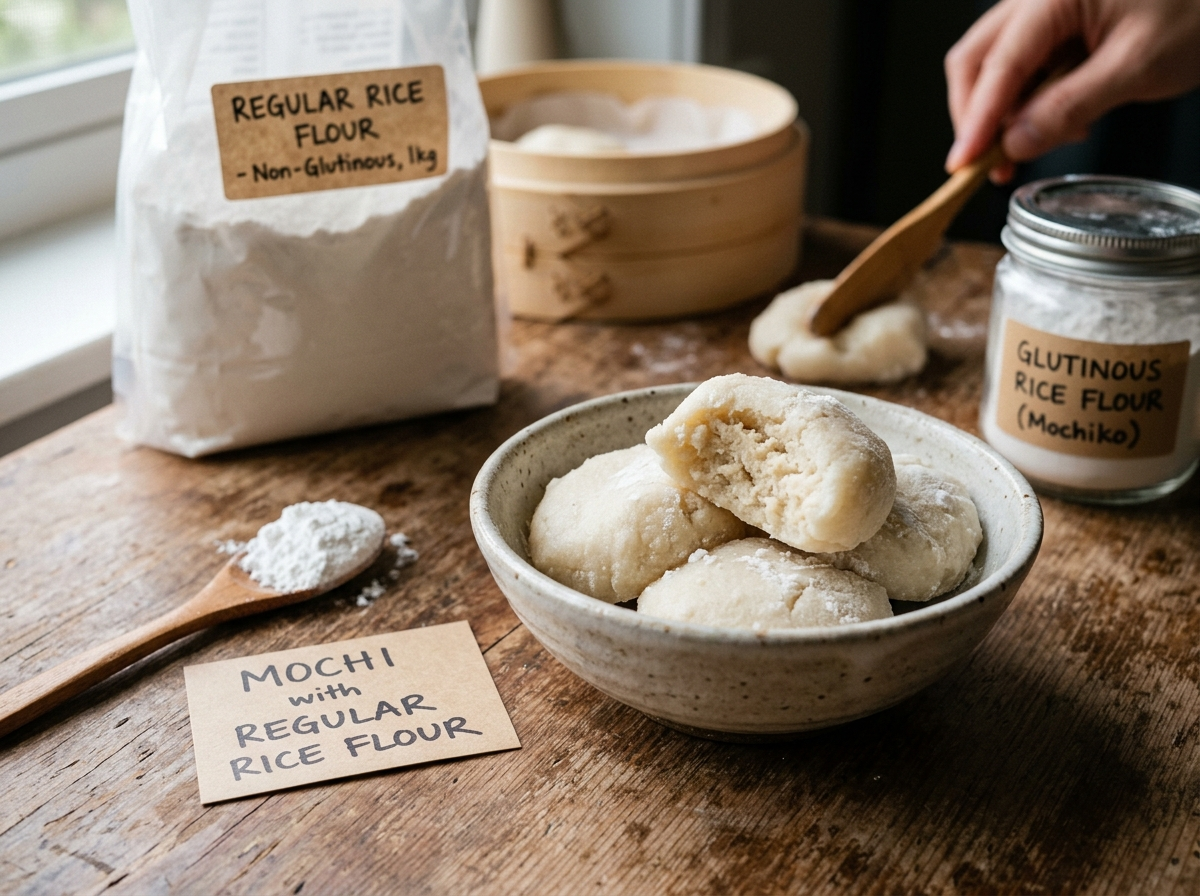
Traditional mochi comes from glutinous rice flour, also called sweet rice flour or mochiko in Japanese. The word “glutinous” throws people off — it has nothing to do with gluten (the wheat protein). It simply means the rice is sticky.
Glutinous rice (Oryza sativa var. glutinosa) has a very specific starch profile. It’s almost entirely made of amylopectin, a branched starch molecule that creates that signature stretchy, chewy, almost gummy texture mochi is famous for.
Regular rice — whether it’s jasmine, basmati, or standard long-grain — contains a mix of amylopectin and amylose. Amylose is a straight-chain starch molecule. It makes rice fluffy when cooked, but it doesn’t stretch. It doesn’t bounce. And it definitely doesn’t give you that satisfying pull-apart quality you want in mochi.
Quick fact: Glutinous rice contains less than 1% amylose, while regular rice can have 15–30% amylose depending on the variety. That difference is everything.
What Happens If You Use Regular Rice Flour Anyway?
Let’s say you ignore the advice and go ahead with regular rice flour. Here’s what you’ll actually get:
The dough will feel grainy during mixing. It won’t come together the way glutinous rice flour does. When you steam or microwave it, instead of becoming a smooth, elastic mass, you’ll end up with something that’s either too dry and crumbly, or too dense and pasty.
The texture will be stiff. You won’t get that stretch. Try pulling it apart and it’ll just break. It’ll also harden fast once it cools down — much faster than real mochi, which stays soft and pliable for hours at room temperature.
The taste is slightly different too. Glutinous rice flour has a subtle sweetness and a clean, neutral flavor that pairs beautifully with fillings like red bean paste, strawberry, or ice cream. Regular rice flour can taste a bit more “ricey” and lacks that delicate quality.
Pro tip: If you’ve already tried this and failed, don’t toss the result. Crumble it into a bowl, mix it with some coconut milk and sugar, and you can actually make a decent rice pudding-style dessert out of it. No waste.
Glutinous Rice Flour vs Regular Rice Flour — The Real Difference
People often assume flour is flour, and rice flour is rice flour. That’s like saying a lemon and an orange are the same because they’re both citrus. Technically related, practically very different.
Starch composition is the core difference. As mentioned, glutinous rice flour is almost pure amylopectin. This particular starch molecule gelatinizes at lower temperatures and creates a network of stretchy, sticky bonds when heated with water. Regular rice flour’s amylose content works against this — it creates firmer, more rigid structures after cooking.
Water absorption also plays a huge role. Glutinous rice flour absorbs water differently. It hydrates more evenly and creates a smoother batter. Regular rice flour tends to stay gritty unless you work with it for longer, and even then, the end result isn’t the same.
Cooking behavior is where you really notice the gap. Heat glutinous rice flour with water and sugar, and it transforms into a glossy, translucent, stretchy mass within minutes. Do the same with regular rice flour, and you get something closer to a thick, opaque paste — think rice glue rather than rice cake.
There’s also the matter of shelf behavior. Mochi made from glutinous rice flour stays soft because amylopectin retrogrades (stiffens) much more slowly than amylose. That’s why real mochi from a Japanese bakery still feels soft hours later, while your regular rice flour experiment turns into a brick in 30 minutes.
So Is There Any Way to Make It Work?
Here’s where things get interesting. You can’t replicate true mochi with regular rice flour alone, but you can hack your way to something reasonably close — if you manage expectations.
Mixing Regular Rice Flour with a Starch
One popular workaround is blending regular rice flour with tapioca starch (also called tapioca flour). Tapioca starch is almost pure amylopectin, just like glutinous rice flour. Adding it to regular rice flour helps introduce some of that stretch and chew.
A common ratio people experiment with is roughly 60% regular rice flour to 40% tapioca starch, though you’ll need to adjust based on your specific flours. The result won’t be identical to traditional mochi, but it’ll be closer. You’ll get some bounce, some stretch, and a softer texture than using regular rice flour alone.
Did you know? Tapioca starch is what gives boba pearls in bubble tea their chewy texture. The same principle applies here — amylopectin-heavy starches create chew.
Using Cornstarch as a Supplement
Some recipes suggest adding cornstarch to regular rice flour for a softer texture. This helps a bit with tenderness, but cornstarch doesn’t bring the same stretchy quality as tapioca starch. You’ll end up with something smoother but still not particularly chewy. It’s better than nothing, but it’s a mild improvement at best.
The Cooked Rice Method
There’s an old-school approach that doesn’t use flour at all. You cook short-grain sticky rice (which is glutinous rice in whole grain form), then pound it in a mortar until it becomes a smooth, elastic mass. This is actually how traditional Japanese mochi is made — the process is called mochitsuki.
If you can find short-grain sticky rice at an Asian grocery store but can’t find glutinous rice flour, this method is your best bet. It takes serious elbow grease (or a stand mixer with a dough hook), but the results are authentic. Cook the rice, then pound or knead it while it’s still hot until it transforms from individual grains into a cohesive, stretchy dough.
Blending with Store-Bought Mochiko
If you can get your hands on even a small amount of mochiko (Japanese glutinous rice flour) or shiratamako (another Japanese glutinous rice product), mixing it with your regular rice flour dramatically improves results. Even a 50-50 blend will give you noticeable stretch and chew, though a higher ratio of glutinous flour always performs better.
Where to Find Glutinous Rice Flour
If you’ve reached this point and decided you want the real thing (smart move), here’s the good news — glutinous rice flour is more accessible than you might think.
Asian grocery stores are your best bet. Look for brands like Mochiko (by Koda Farms, a blue box that’s been around since 1947), Erawan (Thai brand, green package), or Bob’s Red Mill sweet rice flour, which is available in many mainstream supermarkets now.
Online retailers stock it too. Amazon, Walmart’s website, and specialty food stores like H Mart’s online shop all carry multiple brands. A one-pound bag typically costs between $3 and $6 — it’s not expensive.
Warning: Don’t confuse “rice flour” with “sweet rice flour” or “glutinous rice flour” when shopping. They’re often on the same shelf, in similar packaging. Read the label carefully. If it says “rice flour” without “sweet” or “glutinous” in the name, it’s regular rice flour. If you’re shopping at a Thai grocery store, look for the word “Tepung Ketan” (Indonesian) or “Bột Nếp” (Vietnamese) on the packaging — these all refer to glutinous rice flour.
A Simple Mochi Recipe with the Right Flour
Now that you know which flour to use, here’s a straightforward recipe that works every time. This is the microwave method — fast, easy, and no special equipment needed.
What you’ll need:
- 1 cup glutinous rice flour (mochiko)
- ¾ cup water
- ¼ cup granulated sugar
- Cornstarch or potato starch for dusting
How to make it:
Mix the glutinous rice flour, sugar, and water in a microwave-safe bowl. Stir until smooth — no lumps. Cover the bowl loosely with plastic wrap.
Microwave on high for 2 minutes. Take it out and stir. The mixture will look partially cooked and lumpy — that’s fine. Microwave for another 1 to 1.5 minutes. Stir again. It should now look translucent and glossy, and feel very sticky.
Dust your work surface generously with cornstarch or potato starch. Turn the mochi dough out onto the starch. Dust the top with more starch. Let it cool just enough to handle — you want it warm, not hot.
Pinch off small pieces, flatten them in your palm, add your filling (red bean paste, sweetened peanut powder, a small scoop of ice cream), then pinch the edges closed. Roll them smooth.
Pro tip: Keep your hands dusted with starch the entire time. Mochi dough is incredibly sticky, and without starch, you’ll end up wearing more mochi than you’re shaping.
If you enjoy working with sticky rice in other forms, you might like exploring recipes like Chinese pearl balls, which use glutinous rice as a coating around seasoned pork — a totally different application of the same ingredient.
Can You Make Mochi Ice Cream with Regular Rice Flour?
This specific question comes up a lot because mochi ice cream — popularized by brands like My/Mo — has become hugely popular in the West. The thin mochi wrapper around a ball of ice cream needs to be especially pliable and stretchy because it has to wrap around a frozen sphere without cracking.
Regular rice flour absolutely cannot do this. The wrapper would crack, crumble, and fall apart the moment you try to shape it around ice cream. It would also freeze rock-hard, making it impossible to bite through.
For mochi ice cream, you actually need extra-pliable mochi, which means glutinous rice flour is non-negotiable. Some recipes add a tablespoon of vegetable oil or a splash of milk to the dough to keep it softer after freezing.
Other Asian Rice Desserts You CAN Make with Regular Rice Flour
Here’s some good news if you’re stuck with regular rice flour and don’t want to waste it. Several delicious Asian desserts actually call for regular rice flour — it’s not a useless ingredient, it’s just wrong for mochi specifically.
Rice cakes (savory) — Dishes like Korean tteok for tteokbokki use different formulations, and some savory rice cake recipes work well with regular rice flour.
Thai-style rice flour desserts — Khanom krok (coconut rice pancakes) and some versions of khanom tuay (steamed rice cakes) use regular rice flour as the base.
Rice flour pancakes — Thin, crispy Vietnamese bánh xèo uses regular rice flour mixed with turmeric and coconut milk. Totally different from mochi, totally delicious.
Idli and dosa — South Indian breakfast staples made from regular rice flour (or soaked and ground regular rice) combined with urad dal batter.
So don’t throw away that bag of regular rice flour. It has plenty of uses — just not for mochi. And if you’re exploring Asian cooking beyond desserts, something like a teriyaki chicken bowl or Korean fire chicken with cheese might be worth adding to your next dinner rotation.
Understanding Rice Flour Labels — A Quick Guide
Shopping for the right flour is half the battle, especially if you’re browsing an Asian grocery store where packaging might be in multiple languages. Here’s what to look for.
“Mochiko” — This is a Japanese brand name that’s become almost generic for glutinous rice flour in the US. If you see this name, you’re good to go.
“Sweet rice flour” — Same as glutinous rice flour. The “sweet” refers to the sticky texture, not added sugar. This is what you want for mochi.
“Rice flour” — Plain, simple, regular rice flour. Made from non-glutinous rice. Good for many things, but not mochi.
“Shiratamako” — A Japanese product made from glutinous rice that’s been washed, soaked, and finely ground while wet. It produces an even smoother, more refined mochi with a slightly different texture than mochiko. It’s considered premium.
“Dango flour” (dangoko or dango-ko) — A blend of glutinous and regular rice flour. Makes dango (rice dumplings) that are firmer than mochi but still chewy. If you can only find this, it’ll work for mochi — the texture will just be slightly less stretchy.
This distinction matters for getting the results you actually want. It’s the same kind of attention you’d pay when choosing the right cooking wine for a Chinese recipe — the specific variety changes the outcome entirely.
Tips for Perfect Mochi Every Time
A few things experienced mochi makers know that recipes don’t always mention.
Don’t skip the sugar. Sugar isn’t just for sweetness. It helps the mochi stay soft longer by interfering with starch retrogradation. If you reduce or skip sugar, your mochi will harden faster.
Steam trumps microwaving for large batches. The microwave method is great for small quantities (1 cup of flour), but if you’re making mochi for a party or gathering, steaming gives you more even results. Use a steamer basket lined with cheesecloth, spread the batter, and steam for 15–20 minutes.
Eat it the same day. Homemade mochi doesn’t have the preservatives that commercial mochi contains. It’s best within 4–6 hours. After that, it starts losing its softness. You can freeze it, though — frozen mochi keeps well for up to a month. Just thaw it at room temperature for 20–30 minutes before eating.
Work fast. Mochi dough is easiest to shape when it’s warm. Once it cools, it gets stickier and less cooperative. Have your fillings prepped, your starch dusted, and your workspace ready before you take the dough out.
And just like storing cooked rice in the fridge requires knowing the right time frames and methods, storing mochi properly matters for both texture and food safety.
FAQ
Can I substitute regular rice flour for glutinous rice flour in mochi?
No, regular rice flour doesn’t produce the stretchy, chewy texture that defines mochi. The starch composition is fundamentally different — regular rice flour has too much amylose and not enough amylopectin. You’ll end up with a dry, crumbly result that hardens quickly. For authentic mochi, you need glutinous rice flour (sweet rice flour or mochiko).
What can I add to regular rice flour to make it more like mochi?
Mixing regular rice flour with tapioca starch (roughly 60:40 ratio) can help introduce some chewiness. Tapioca starch is high in amylopectin, which brings some of that stretch and bounce. The result won’t be identical to traditional mochi, but it’ll be significantly better than using regular rice flour alone.
Is glutinous rice flour the same as regular rice flour?
Not at all. They come from different types of rice. Glutinous rice flour is made from sticky rice (short-grain, waxy rice) and is almost entirely amylopectin starch. Regular rice flour comes from standard rice varieties and contains a significant amount of amylose starch. They behave completely differently when cooked and can’t be used interchangeably in recipes where texture matters.
Does glutinous rice flour contain gluten?
No. Despite the confusing name, glutinous rice flour is 100% gluten-free. The word “glutinous” here refers to the glue-like sticky texture of the cooked rice, not the gluten protein found in wheat, barley, and rye. It’s safe for people with celiac disease or gluten sensitivity.
Why does my homemade mochi get hard so fast?
Several factors could be at play. If you used regular rice flour, that’s the main culprit — it hardens very quickly. If you used the right flour, check your sugar ratio. Sugar helps keep mochi soft by slowing starch retrogradation. Also, exposure to air dries mochi out. Keep finished mochi covered with plastic wrap until you’re ready to serve.
Your Next Move
So here’s the bottom line — regular rice flour and mochi just don’t get along. The science behind it is clear. Different starch, different behavior, different results. You can try workarounds like adding tapioca starch, and they’ll get you partway there, but if you want the real deal, pick up a bag of glutinous rice flour. It’s cheap, it’s easy to find, and the difference in your finished mochi will be night and day.
Once you’ve got the right flour in your pantry, making mochi at home becomes genuinely simple. A few minutes in the microwave, some starch for dusting, and your favorite filling — that’s really all it takes. Give it one try with the proper ingredients, and you’ll understand why this is a dessert that’s been loved across Asia for centuries.