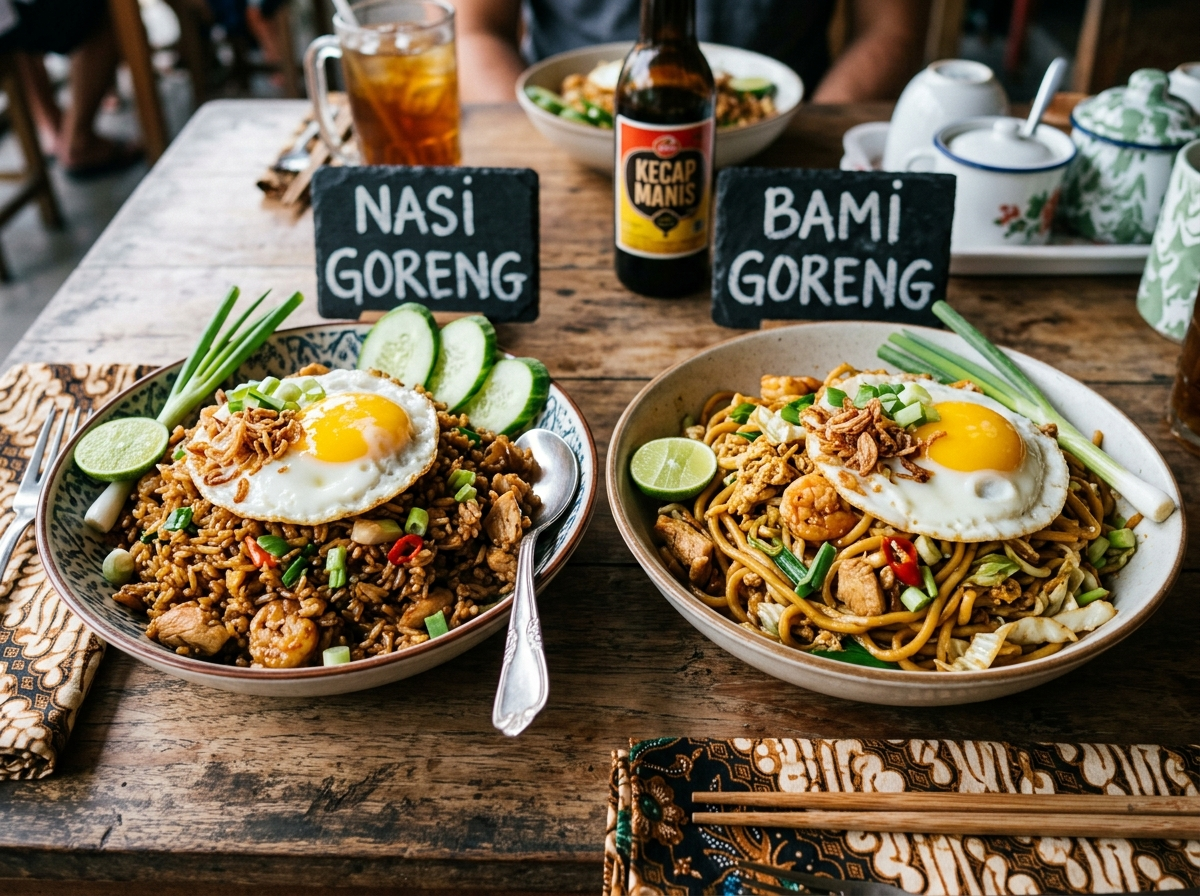
Walk into any Indonesian street food stall, a Dutch-Indonesian takeaway in Amsterdam, or a Southeast Asian restaurant anywhere in the world, and two dishes will almost always be on the menu: Bami Goreng and Nasi Goreng. They sound similar. They often share the same sauces and toppings. And if you’ve never tried them, they can seem practically interchangeable on paper.
But here’s the thing — they’re not the same dish. One is built around noodles, the other around rice, and that single difference changes everything about the texture, cooking technique, and even how you eat them. If you’ve ever stared at a menu wondering which one to order, or you’re planning to cook one at home and can’t decide, this guide breaks it all down for you. No fluff, just honest answers.
What Exactly Is Bami Goreng?
Bami Goreng (sometimes spelled “Bakmi Goreng” or “Mie Goreng”) literally translates to “fried noodles” in Malay and Indonesian. “Bami” or “Bakmi” comes from the Hokkien Chinese word for noodles, and “Goreng” means fried. So, at its core, this is a stir-fried noodle dish.
The noodles used are typically egg noodles — thin or medium thickness — and they’re stir-fried in a hot wok with a combination of sweet soy sauce (kecap manis), garlic, shallots, chili paste, and whatever protein and vegetables the cook has on hand. Chicken, shrimp, pork, or tofu are all common additions. A fried egg on top is practically mandatory in many regions.
What makes Bami Goreng special isn’t just the ingredients. It’s the wok hei — that smoky, charred flavor you get from cooking at extremely high heat. Street vendors in Jakarta or Bandung cook this dish over flames so intense that the noodles pick up a slightly caramelized, almost toasty quality you simply can’t replicate on a standard home stove. That said, you can get pretty close with a well-seasoned cast iron pan and some patience.
Quick Fact: Bami Goreng has strong Chinese-Indonesian roots. When Chinese immigrants settled in Indonesia centuries ago, they brought noodle-making traditions that blended with local spices and sauces, creating a distinctly Indonesian dish that still carries those Chinese culinary fingerprints.
What Exactly Is Nasi Goreng?
Nasi Goreng translates to “fried rice.” “Nasi” means rice, and “Goreng” — you already know — means fried. It’s Indonesia’s national dish, quite literally. In 2018, CNN listed it among the world’s best foods, and the Indonesian government has recognized it as one of the country’s five national dishes.
The preparation starts with cold, day-old rice — and this detail matters a lot. Freshly cooked rice is too moist and sticky to fry properly. You want grains that have dried out slightly in the fridge overnight. Those separated, firmer grains absorb the seasonings better and get that satisfying, slightly chewy texture when they hit the hot wok.
The seasoning base is remarkably similar to Bami Goreng: kecap manis, garlic, shallots, chili (often sambal or fresh bird’s eye chilies), and sometimes a touch of shrimp paste (terasi) for that deep, umami funk. Protein options mirror the noodle version too — chicken, shrimp, egg, or tofu.
If you’re someone who regularly stores cooked rice in the fridge, you already have a head start on making authentic Nasi Goreng. That leftover rice sitting in your container is basically waiting to become this dish.
Pro Tip: The best Nasi Goreng has a slightly smoky, caramelized quality at the bottom of the serving — almost like a thin crust of rice that’s been kissed by direct flame. Street vendors achieve this naturally. At home, resist the urge to stir constantly. Let the rice sit against the hot pan for 30–45 seconds between tosses.
Bami Goreng vs Nasi Goreng: The Core Differences
Let’s get into what actually sets these two apart beyond just “noodles vs. rice.” Because when you look closely, the differences affect your entire eating experience.
The Base Ingredient Changes Everything
This is the obvious one, but it deserves more attention than most people give it. Egg noodles and day-old rice don’t just differ in shape — they interact with sauces, heat, and seasonings in completely different ways.
Noodles are slippery. They wrap around your fork or chopsticks, and the sauce clings to their surface in a thin, glossy coat. Every bite delivers a concentrated hit of flavor because the sauce sits on the noodle rather than being absorbed into it.
Rice, on the other hand, absorbs the sauce. Each grain soaks up the kecap manis, the garlic oil, the chili — and the flavor becomes more integrated, more mellow, more evenly distributed. You don’t get that sharp burst of sauce flavor, but you get a deeper, more unified taste throughout the dish.
This is why some people swear Bami Goreng tastes “stronger” or “more flavorful” than Nasi Goreng, even when the exact same seasonings are used. It’s not about more sauce — it’s about how the base ingredient carries it.
Texture and Mouthfeel
Bami Goreng gives you chew. Properly cooked egg noodles have a springy, bouncy quality that’s satisfying in a very particular way. There’s resistance when you bite down, and the noodles have enough structure to hold up against crunchy vegetables and tender protein.
Nasi Goreng offers something different — individual grains with a slight firmness on the outside and softness within. Good fried rice has textural contrast built right into the rice itself. And when some of those grains get extra-toasty from the wok, you get little pops of crunch scattered throughout the dish.
Neither texture is “better.” They’re just different eating experiences, and your preference on any given day might depend entirely on your mood.
Cooking Technique
Both dishes require a screaming-hot wok and fast hands, but the technique differs in subtle ways.
With Bami Goreng, you’re managing noodles that want to clump. The biggest challenge is keeping the strands separate while distributing the sauce evenly. You need to toss constantly, and many cooks add a splash of water or oil during stir-frying to prevent sticking. Overcooking the noodles beforehand is the number one mistake — they should be slightly underdone (al dente, if you want to borrow Italian terminology) because they’ll continue cooking in the wok.
With Nasi Goreng, the challenge is different. You need to break up the cold rice without mashing it. Gentle tossing, not aggressive stirring. The wok needs to be dry enough that the rice fries rather than steams. Too much moisture and you end up with soggy, clumpy fried rice — which is basically a culinary crime in Southeast Asian cooking.
Satiety and Heaviness
Here’s a practical consideration that most food articles ignore: these two dishes fill you up differently.
Nasi Goreng tends to be more filling per serving. Rice is calorie-dense and starchy, and it sits heavier in your stomach. If you’re eating this as your main meal after a long day, it’ll keep you satisfied for hours.
Bami Goreng feels lighter by comparison, even though egg noodles aren’t exactly a diet food. You can eat a full plate and still feel relatively comfortable afterward. This makes it a solid choice for lunch or for situations where you don’t want that heavy, post-meal drowsiness.
The Flavor Profile: Similar But Not Identical
Here’s where things get interesting. Both dishes use kecap manis (sweet soy sauce) as their backbone flavoring agent. Both rely on garlic, shallots, and chili. Both often include terasi (shrimp paste). So why do they taste different?
Part of the answer goes back to what we discussed about sauce absorption. But there’s another factor most people overlook: the Maillard reaction behaves differently on noodles versus rice.
When rice grains hit a blazing-hot wok, the surface starches caramelize and create a nutty, toasty flavor that’s unique to fried rice. Noodles caramelize too, but because of their shape and surface area, the effect is more subtle. Instead, noodles pick up more of the wok hei — that smoky, almost charcoal-like flavor — because their thinner profile exposes more surface area directly to the flame.
The result? Nasi Goreng tends to taste nuttier and more rounded. Bami Goreng tends to taste smokier and more sauce-forward.
And if you’re using Chinese cooking wine in your stir-fry base (which some cooks do for either dish), that alcohol hit creates an extra layer of flavor complexity that plays out differently in noodles versus rice. In noodles, it adds a sharpness. In rice, it mellows into the background.
Regional Variations You Should Know About
Neither Bami Goreng nor Nasi Goreng is a single, fixed recipe. Both dishes vary wildly depending on where you eat them.
Indonesian Versions
In Indonesia, both dishes tend to be sweeter and more intensely flavored than their counterparts elsewhere. Kecap manis is used generously, and the dishes often have a dark, almost mahogany color from the sauce. Street-stall versions in Java might include bakso (meatballs), kerupuk (shrimp crackers), and a heavy dose of sambal on the side.
Nasi Goreng Kampung (village-style fried rice) is a stripped-down version with anchovies, sambal, and minimal vegetables — deeply savory and rustic. There’s no equivalent “kampung” version for Bami Goreng, which tells you something about how rice occupies a different cultural space than noodles in Indonesia.
Dutch-Indonesian Versions
The Netherlands has a massive Indonesian food culture — a legacy of colonial history. Dutch-Indonesian restaurants serve both Bami and Nasi Goreng as part of “rijsttafel” (rice table) spreads, and the flavors are often toned down slightly compared to authentic Indonesian versions. Less chili heat, sometimes more vegetables, and occasionally a hint of curry powder that you wouldn’t find in Indonesia.
Interestingly, in Dutch casual dining, Bami and Nasi Goreng are often served together as a combo. You’ll see it listed as “Bami Nasi” on menus — literally half noodles, half rice on one plate. It’s not traditional, but it’s popular, and honestly? It’s a pretty great way to get the best of both worlds.
Malaysian and Singaporean Takes
In Malaysia and Singapore, you’ll find Mee Goreng (their spelling of Bami Goreng) that’s often spicier and tangier than Indonesian versions. Malaysian Mee Goreng sometimes includes ketchup or tomato sauce — which sounds weird but actually works. It creates a slightly sweet, tangy base that’s distinctly different from the kecap manis-heavy Indonesian original.
Malaysian Nasi Goreng, meanwhile, often features anchovy-based sambal and is more pungent thanks to heavier use of belacan (shrimp paste).
Which One Should You Order?
Alright, let’s get practical. You’re sitting in a restaurant, the server is waiting, and you need to make a decision. Here’s a simple framework.
Go with Bami Goreng if: you want something that feels lighter, you enjoy the chewiness of noodles, you prefer a more sauce-forward flavor, or you had a heavy lunch and don’t want to overdo it at dinner. It’s also a solid pick if you’re sharing multiple dishes — noodles make a nice contrast on a table full of rice-based items.
Go with Nasi Goreng if: you’re genuinely hungry and want something filling, you love the comfort of fried rice, you prefer flavors that are more integrated and mellow rather than punchy, or you want the “true” Indonesian national dish experience. Nasi Goreng also pairs better with side dishes like satay, since rice is a natural partner for grilled meat and peanut sauce.
And if you’re trying both for the first time? Honestly, order one of each and share with someone. That’s the best possible introduction.
Speaking of Malaysian satay, pairing grilled satay skewers with Nasi Goreng is one of those combinations that just makes sense. The peanut sauce from the satay mingles with the fried rice in a way that feels almost intentional.
How to Make Both at Home: Key Tips
You don’t need a commercial wok burner to make decent Bami or Nasi Goreng at home. Here’s what actually matters.
For Bami Goreng
Start with good egg noodles. Fresh noodles from an Asian grocery store are ideal, but dried egg noodles work fine. Boil them until they’re just shy of done — slightly firm in the center. Drain them, toss with a tiny bit of oil to prevent sticking, and spread them on a plate to cool slightly before stir-frying.
Your sauce mix should be ready before anything hits the wok: kecap manis, regular soy sauce, a pinch of white pepper, and minced garlic. Some cooks add oyster sauce for extra depth. Have all your vegetables chopped, your protein sliced thin, and everything within arm’s reach. Once the wok is hot, things move fast.
The biggest mistake home cooks make? Overcrowding the wok. If you’re cooking for more than two people, do it in batches. A crowded wok drops in temperature, and your noodles will steam instead of fry. That’s the difference between restaurant-quality Bami Goreng and a sad, soggy plate of noodles.
For Nasi Goreng
The rice situation is non-negotiable: use cold, day-old rice. Cook your rice the night before, spread it on a sheet pan, and refrigerate it uncovered. By the next day, the grains will be dry, separate, and perfect for frying.
Your sauce base is similar to Bami Goreng but you can go a bit heavier on the kecap manis since the rice absorbs more. Some authentic recipes include a small amount of terasi (shrimp paste) fried in oil as the first step — it smells intense (fair warning, your kitchen will smell like a fishing dock for about 30 seconds) but it adds an umami backbone that’s hard to replicate any other way.
Fry your aromatics first (garlic, shallots, chili), add your protein, then throw in the rice. Use the back of your spatula to break up any clumps, and press the rice against the wok surface periodically to get that coveted toasty crust.
A fried egg on top isn’t optional. It’s essential. Runny yolk preferred — when you break it and mix it into the rice, it creates a rich, silky coating that ties everything together.
If you enjoy Asian-inspired cooking at home, you might also want to try your hand at making potstickers or a teriyaki chicken bowl — both use similar wok skills and pantry staples.
Nutritional Comparison: Does It Matter?
People ask about this, so let’s address it honestly. Neither Bami Goreng nor Nasi Goreng is a health food. Both are stir-fried in oil, both contain sodium from soy sauce, and both are carb-heavy. That’s the reality of comfort food, and there’s nothing wrong with enjoying it.
That said, there are some differences worth noting. A standard serving of Nasi Goreng (using about 1.5 cups of cooked rice) typically lands around 350–500 calories, depending on the protein and how generous the cook is with oil and kecap manis. Bami Goreng tends to be slightly lower, coming in at roughly 300–450 calories for a comparable serving, because noodles are less calorie-dense by volume than rice.
Both dishes are relatively low in fiber unless you load them up with vegetables. And both can be surprisingly high in sugar thanks to kecap manis, which is essentially soy sauce sweetened with palm sugar.
If you’re watching your intake, the easiest adjustment is to increase the vegetable-to-base ratio. More cabbage, more bean sprouts, more scallions — these add bulk and nutrition without dramatically changing the character of the dish.
The Cultural Significance You Might Not Know
Food is never just food, and these two dishes carry real cultural weight.
Nasi Goreng holds a special place in Indonesian identity. Rice is the foundation of Indonesian cuisine — it’s not just a side dish or a base; it’s the meal itself. Everything else on the plate is “lauk” (accompaniments to rice). When Indonesians say “makan” (eat), they often implicitly mean eating rice. A meal without rice, for many Indonesians, doesn’t quite count as a full meal. So Nasi Goreng isn’t just fried rice — it’s a representation of Indonesian food culture’s relationship with rice.
Bami Goreng represents something else: Indonesia’s rich history of cultural blending. The Chinese-Indonesian community created this dish by adapting Chinese noodle-cooking techniques to Indonesian ingredients and palates. It’s a culinary bridge between two cultures, and it’s become so fully integrated into Indonesian food that most people don’t even think of it as “Chinese food” anymore. It’s just… Indonesian.
In the Netherlands, both dishes played a fascinating role in post-colonial food culture. After Indonesian independence in 1945, many Indo (mixed Dutch-Indonesian) families migrated to the Netherlands and brought these recipes with them. Today, Nasi Goreng and Bami Goreng are among the most popular takeaway foods in the entire country. A 2019 survey found that Nasi Goreng was the third most-ordered delivery dish in the Netherlands — behind pizza and shoarma.
What About Bami Goreng Nasi? (The Combo Plate)
Yes, this exists. And yes, it’s worth trying.
In Dutch-Indonesian eateries and across parts of Southeast Asia, you can get a plate that’s literally half Bami Goreng and half Nasi Goreng side by side. It’s sometimes called “Bami Nasi” or “Nasi Bami,” and it’s perfect for indecisive eaters.
The combo plate also works surprisingly well from a flavor perspective. You get the chewiness and sauce-forward punch of the noodles alongside the nutty, mellow comfort of the fried rice. They complement each other instead of competing.
If you’re cooking at home for a group, serving both dishes is always a crowd-pleaser. Lay them out alongside some Asian sticky wings and a plate of kerupuk (shrimp crackers), and you’ve got a spread that’ll disappear in minutes.
FAQ
Is Bami Goreng the same as Mie Goreng?
Essentially, yes. “Bami Goreng” and “Mie Goreng” refer to the same dish — Indonesian/Malay fried noodles. “Bami” (or “Bakmi”) comes from the Hokkien Chinese dialect, while “Mie” is the more commonly used Indonesian/Malay word for noodles. You’ll see “Mie Goreng” used more frequently in Indonesia itself, while “Bami Goreng” is more common in the Netherlands and European menus. The recipe and technique are the same.
Can I make Nasi Goreng with fresh rice instead of day-old rice?
You can, but you shouldn’t expect the same results. Fresh rice contains too much moisture, which means it’ll steam in the wok instead of frying. You’ll end up with a mushy, clumpy mess instead of distinct, toasty grains. If you’re in a pinch, cook the rice, spread it thin on a baking sheet, and let it cool uncovered in the fridge for at least 2–3 hours. It’s not as good as true overnight rice, but it’s a workable shortcut.
Is Nasi Goreng spicy?
It depends entirely on who’s cooking it. Traditional Indonesian Nasi Goreng can range from mildly seasoned to fiery hot, depending on how much sambal or fresh chili the cook uses. Restaurant versions outside of Indonesia tend to be milder. If you’re cooking at home, you have full control — start with a small amount of chili and add more to taste. You can always add heat; you can’t take it away.
Which is more popular worldwide — Bami Goreng or Nasi Goreng?
Nasi Goreng is more widely recognized internationally. It’s been featured on numerous “best foods in the world” lists, and it holds the status of Indonesia’s national dish. Bami Goreng is well-known too, especially in the Netherlands, Suriname, and parts of Southeast Asia, but it doesn’t carry the same level of global name recognition. That said, popularity doesn’t determine quality — both dishes are equally beloved by the people who grew up eating them.
Can I make either dish vegetarian or vegan?
Absolutely. Skip the shrimp paste (terasi/belacan), use vegetable oil instead of any animal fat, and load up on tofu, tempeh, mushrooms, and vegetables as your protein. Replace oyster sauce with mushroom sauce or extra kecap manis. The dishes adapt beautifully to plant-based cooking without losing their essential character.
Your Next Move
You’ve made it this far, so here’s what I’d suggest: make both. Seriously. Pick a weekend, get yourself some egg noodles and a batch of day-old rice, grab a bottle of kecap manis from your nearest Asian grocery store, and cook Bami Goreng and Nasi Goreng back to back. Taste them side by side. That hands-on comparison will tell you more about these two dishes than any article ever could.
And once you’ve got those wok skills warmed up, branch out. Try a gochujang chicken stir-fry or tackle a bowl of homemade pho. The more you cook Southeast and East Asian food at home, the more intuitive it becomes — and the better your Bami and Nasi Goreng will get with each attempt.
The real winner of Bami Goreng vs Nasi Goreng? Whichever one you’re eating right now.