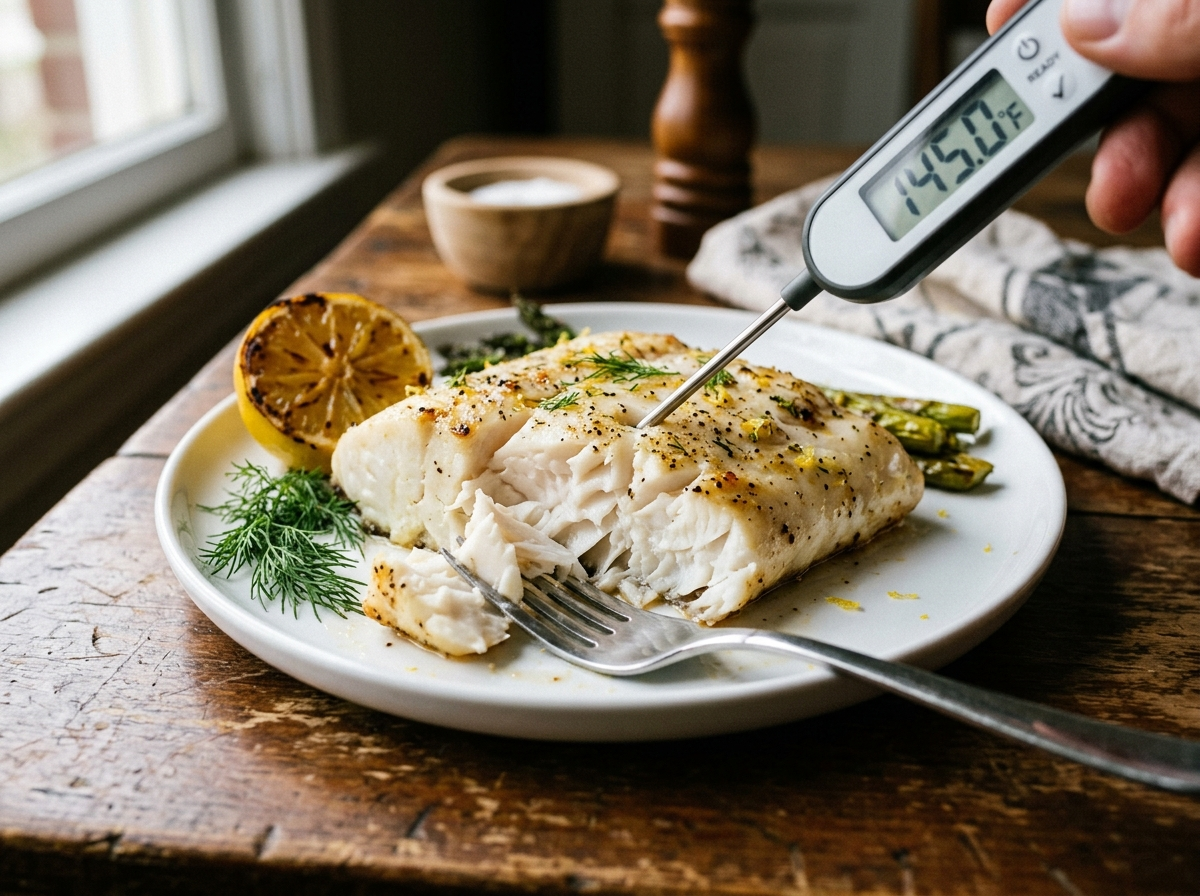
A small 5°F change can be the difference between tender halibut and a dry, chalky fillet. That’s why so many home cooks search for the right halibut internal temperature right before dinner hits the oven or grill. If you want the short answer, 145°F is the official safe temperature for fish, but the best texture often comes from checking early and using carryover heat wisely.
What Internal Temperature Should Halibut Be When Done?
The safest public-health answer is simple: halibut is done at 145°F (63°C) in the thickest part. That matches standard FDA and USDA guidance for fish in home kitchens.
Still, if you’ve cooked halibut before, you may have noticed a problem. By the time the fish sits at 145°F for long, it can lose that soft, juicy feel. Halibut is a lean white fish, so it doesn’t have much fat to protect it from overcooking.
That’s why you’ll see two different numbers online. One is the safe temperature. The other is the texture target that many cooks use to keep halibut moist.
Here’s the practical way to think about it:
| Your goal | Pull temperature | Finish temperature after rest | Texture |
|---|---|---|---|
| Follow FDA/USDA guidance | 140–142°F | about 145°F | firm, flaky, fully opaque |
| Tender home-cooked result | 135–138°F | about 138–142°F | moist, soft flakes |
| Chef-style softer center | 130–135°F | about 133–138°F | silky, delicate, less firm |
The first row is the safe answer for most home cooks. The second row is what many people like best for texture. The third row is not standard home food-safety guidance, so use caution.
Quick fact: Halibut often keeps cooking for a few minutes after you take it off the heat. That extra rise is called carryover cooking.
So which number should you use?
If you’re cooking for kids, older adults, pregnant guests, or anyone with a weaker immune system, stick with 145°F. If your goal is restaurant-style texture and you understand the trade-off, you can pull it sooner and let the fish finish gently as it rests.
A good middle ground for many home cooks is this: take the fillet off the heat around 140°F if it’s thick, then rest it for 3 to 5 minutes. You’ll usually land close to the safe mark without turning it dry.
That’s the part many ranking articles skip. They give one number and stop there. But your real question probably isn’t just “What number is done?” It’s more like, “How do I make halibut safe and still pleasant to eat?” The answer lives in that small gap between pull temp and finish temp.
Why Halibut Gets Dry So Fast
Halibut is lean, so the margin is small
Halibut behaves a lot like a chicken breast of the sea. It’s mild, clean-tasting, and naturally lean. That sounds great until you cook it a few minutes too long.
Fish like salmon carry more fat, which gives you a wider safety net. Halibut doesn’t. Once the muscle fibers tighten too much, moisture escapes. Then the fish goes from juicy to cottony fast.
That’s also why halibut and other lean white fish follow similar doneness patterns. If you cook cod or tilapia often, you’ll see the same narrow window between perfect and overdone. Our guides on cooked cod temperature and tilapia done temp show that same pattern in a slightly different fish.
Carryover heat can trick you
A hot pan, sheet pan, or grill grate keeps sending heat into the fish even after you remove it. Thick halibut fillets can rise another 3 to 5 degrees while resting. Thin pieces may only rise 1 to 2 degrees.
That’s why waiting until the fish already reads 145°F in the pan can overshoot the finish line. By the time you plate it, the center might be 148°F or more.
You can think of it like toast. If you wait until it already looks a little too dark in the toaster, it’s definitely too dark by the time it pops up. Halibut works the same way.
Thickness matters more than time
One fillet may be half an inch thick. Another may be almost two inches. If you use the same cook time for both, one turns raw in the middle and the other ends up dry.
Most home cooks buy Pacific halibut fillets, often from Alaska or the North Pacific, and those cuts vary a lot. Some have a thick center and a thin tail end. That uneven shape is one reason time-based recipes can feel so frustrating.
So yes, time helps. But temperature tells the truth.
How to Check Halibut Internal Temperature the Right Way
Use an instant-read thermometer
If you cook seafood more than once in a while, a digital instant-read thermometer makes life easier. You don’t need a fancy setup. You just need a tool that reads fast and clearly.
Checking the temperature takes only a few seconds, and it removes almost all the guessing.
Here’s the best way to do it:
- Insert the probe into the thickest part of the fillet.
- Go in from the side if you can, not straight down from the top.
- Stop when the tip reaches the center.
- Don’t let the probe touch the pan, tray, or bone.
That side-entry trick matters a lot. Halibut fillets are often not very tall, so going straight down can easily pass through the fish and give you a bad reading.
Pro tip: Start checking the temperature 1 to 2 minutes before you think the fish will be done. Fish cooks faster at the end than most people expect.
Check more than one spot if the fillet is uneven
A tapered fillet cooks unevenly. The skinny end may already be done while the thick center still needs a minute or two.
If the piece is large, test the thick center first. Then check a second spot closer to the middle-thin section. That helps you avoid serving one end dry and the other undercooked.
For a halibut steak, test near the center but stay away from the bone. Bone holds heat differently and can throw off the reading.
What the numbers mean in real life
Numbers feel abstract until you connect them to what’s on your plate.
At around 125°F to 130°F, halibut usually still looks a bit glossy in the center. It may not flake well yet.
At 130°F to 135°F, the fish begins to set. The center may still look slightly moist and soft, but it’s much closer.
At 135°F to 140°F, most fillets look opaque and flake with light pressure. Many people like this range best for texture.
At 145°F, halibut is fully done by standard safety guidance. The flesh should be opaque all the way through and separate easily.
Past that, the risk of dryness climbs fast.
Warning: Thin halibut can jump from 135°F to 145°F in less time than it takes to set the table. Don’t walk away near the end.
Resting helps more than people think
Give halibut a short rest after cooking, usually 3 to 5 minutes. That pause lets the heat settle and the juices stay in the fish instead of running onto the plate.
If you slice or flake it the second it leaves the heat, you can lose moisture that would’ve stayed in the fillet.
Resting doesn’t need to be fancy. Just move the fish to a warm plate and leave it alone for a moment.
Best Halibut Cooking Temps by Method
The cooking method changes your timing, but not your goal. You still want the thickest part to reach the right internal temperature without overshooting it.
Here’s a quick method guide for a 1-inch thick halibut fillet.
| Method | Cooking temperature | Approx cook time | Start checking temp | Good pull range |
|---|---|---|---|---|
| Bake | 400°F to 425°F | 8 to 12 min | 7 min | 135–142°F |
| Pan-sear | Medium to medium-high heat | 3 to 4 min per side | after first flip | 135–142°F |
| Grill | 400°F to 450°F grill heat | 6 to 10 min | 5 to 6 min | 135–142°F |
| Air fryer | 375°F to 400°F | 7 to 10 min | 6 min | 135–142°F |
Time changes with thickness, starting temperature, and whether the fish is skinless or bone-in. Use the chart as a head start, not a promise.
Baked halibut: best oven temperature and doneness
Baking is one of the easiest ways to cook halibut because the heat is steady and gentle compared with a screaming hot skillet.
For most fillets, 400°F is the sweet spot. It cooks the fish fairly fast but still gives you a bit of room to react. If you bake at 425°F, the fish browns a little more and cooks faster, so start checking earlier.
A simple example helps. Say you have a 1-inch halibut fillet brushed with olive oil and seasoned with salt, pepper, and lemon. At 400°F, start checking around the 7-minute mark. If the center reads 132°F, give it another minute or two. If it’s already 140°F, pull it.
If the tail end is much thinner than the center, tuck that end under itself before baking. That single move can save the thin part from drying out.
Pan-seared halibut: fast, tasty, easy to overcook
Pan-searing gives halibut a beautiful crust, but it also creates the highest overcooking risk.
Pat the fish dry first. A dry surface sears better. Warm a skillet over medium or medium-high heat, add a little oil, then cook the fillet until it releases easily. Flip once and finish the second side.
Most 1-inch fillets take around 3 to 4 minutes per side, but watch the temperature, not the clock.
A smart move is to lower the heat slightly after flipping. The first side builds color. The second side finishes the center.
If you want a crisp outside and still-moist fish inside, pull it from the pan a bit before your final target and let it rest.
Grilled halibut: great flavor, extra care
Grilling halibut tastes excellent, but the grate and open heat can dry lean fish fast.
Aim for a grill temperature around 400°F to 450°F. Clean and oil the grates so the fish doesn’t stick. If the fillet is delicate, a fish basket or a piece of foil can help.
Check the center early. Grills often cook unevenly, and hot spots are common. A thick center may still be behind even if the edges look ready.
If you like grilling fish often, the heat setup ideas in our best temp to grill salmon guide can help you dial in similar grill conditions for halibut too.
Fried halibut: crispy outside, moist center
Frying brings another layer of timing because the coating can look done before the fish actually reaches the right internal temperature.
For battered or breaded halibut, oil temperature usually lands around 350°F to 375°F. The crust should turn golden while the center cooks through. Still, don’t trust color alone.
If frying is your go-to method, our guide on how long to fry fish can help with timing so the crust and center finish closer together.
A quick thermometer check through the side of the fillet is still the safest move.
Air fryer halibut: quick and clean
Air fryers work well for halibut because they cook fast and keep cleanup simple. Set the air fryer around 375°F to 400°F and check early. A 1-inch fillet often finishes in 7 to 10 minutes.
Because air fryers blow hot air hard, the surface can dry before the center catches up. A light brush of oil helps.
Pull the fish once it hits your chosen range, then let it rest just like you would with oven-baked halibut.
Don’t cook halibut straight from fully frozen if you want the best texture
You can cook some fish from frozen, but halibut usually turns out better if you thaw it first. Frozen centers slow the cook while the outside keeps taking heat. That makes dryness more likely.
If you do cook from frozen, lower your expectations on texture and start checking often once the fish begins to thaw in the heat.
How to Tell When Halibut Is Done Without a Thermometer
A thermometer is your best tool, but sometimes you don’t have one handy. In that case, use a mix of visual signs and touch.
Look for opaque flesh
Raw halibut looks glossy and a bit see-through. As it cooks, the flesh turns white and opaque.
If the center still looks clearly translucent, it likely needs more time. If the whole fillet looks stark white and starts cracking apart, you may already be past the sweet spot.
Watch how it flakes
Press gently with a fork or the tip of a knife at the thickest part. Done halibut should separate into flakes with light pressure.
The key phrase there is light pressure.
If the fish resists and stays dense, it needs more time. If it shreds into dry pieces the second you touch it, it probably cooked too long.
Halibut should flake in moist, large pieces, not dry splinters.
Use the “knife peek” trick
Slide a thin knife into the center, hold it there for a few seconds, then touch the blade carefully. If it feels warm and the flesh at that spot looks opaque and softly set, the fish is close.
It’s not as accurate as a thermometer, but it works better than guessing by time alone.
Common mistakes that fool home cooks
A few habits cause most halibut problems:
- Waiting for the fish to look “very firm” before pulling it
- Trusting cook time without checking thickness
- Cutting into the fillet too early
- Forgetting carryover heat
- Cooking thin and thick pieces together without adjusting
A lot of people also compare halibut to salmon. That can be misleading. Salmon has more fat, so it stays forgiving longer. Halibut doesn’t.
If you want to see how doneness signs change in a richer fish, our guide on how to know when salmon is done makes that contrast clear.
Did you know? The old “10 minutes per inch” fish rule still works as a rough starting point, but modern ovens, air fryers, and pan-searing styles can shift that by a lot. Always let temperature make the final call.
FAQ Section
What temperature should halibut be cooked to?
For home food safety, cook halibut to 145°F in the thickest part. If you want to avoid dryness, many cooks remove it from the heat around 140–142°F and let it rest so carryover heat finishes the job.
Is halibut done at 130°F?
At 130°F, halibut is usually very close but not fully done by standard FDA or USDA home-cooking guidance. Some chefs like the texture in that range, especially after a short rest, but it is a texture choice, not the official safety target.
Can halibut be a little translucent in the middle?
Slight translucence in the center can happen in fish that is just shy of fully done. Halibut is usually best once the center looks mostly opaque and flakes gently. If you want the safest result, keep cooking until the thickest part reaches 145°F.
What is the best oven temperature for halibut?
Most home cooks get great results baking halibut at 400°F. It cooks evenly and gives you time to check the fish before it dries out. If you bake at 425°F, start checking earlier because the fish finishes faster.
How long does halibut take to cook?
A 1-inch thick halibut fillet usually takes about 8 to 12 minutes in a 400°F oven, 6 to 10 minutes on a grill, or around 3 to 4 minutes per side in a skillet. Thickness changes everything, so use those times as a guide and confirm with internal temperature.
Why does my halibut always come out dry?
Dry halibut usually means it stayed on the heat too long. Because halibut is lean, even a few extra degrees can push it past the juicy stage. Start checking early, pull it before it overshoots, and let it rest for a few minutes.
How long should cooked halibut rest before serving?
Let halibut rest for 3 to 5 minutes after cooking. That short pause helps the juices settle and lets carryover heat finish the center gently.
How long does cooked halibut last in the fridge?
Cooked halibut generally keeps for about 3 to 4 days in the fridge if you chill it promptly and store it well. If you want a practical storage reference, our cooked salmon in fridge guide covers the same basic rule most cooked fish follows.
Final Thoughts on Cooking Halibut Perfectly
If you remember just one number, remember 145°F. If you remember one habit, make it this: start checking early. That single change saves more halibut than any fancy recipe ever will.
Use a thermometer, aim for the thickest part, and let the fish rest a few minutes before serving. After one or two tries, you’ll learn the exact finish you like best—firm and fully cooked, or a touch more tender. Next time halibut is on your menu, trust the temperature, not the clock.