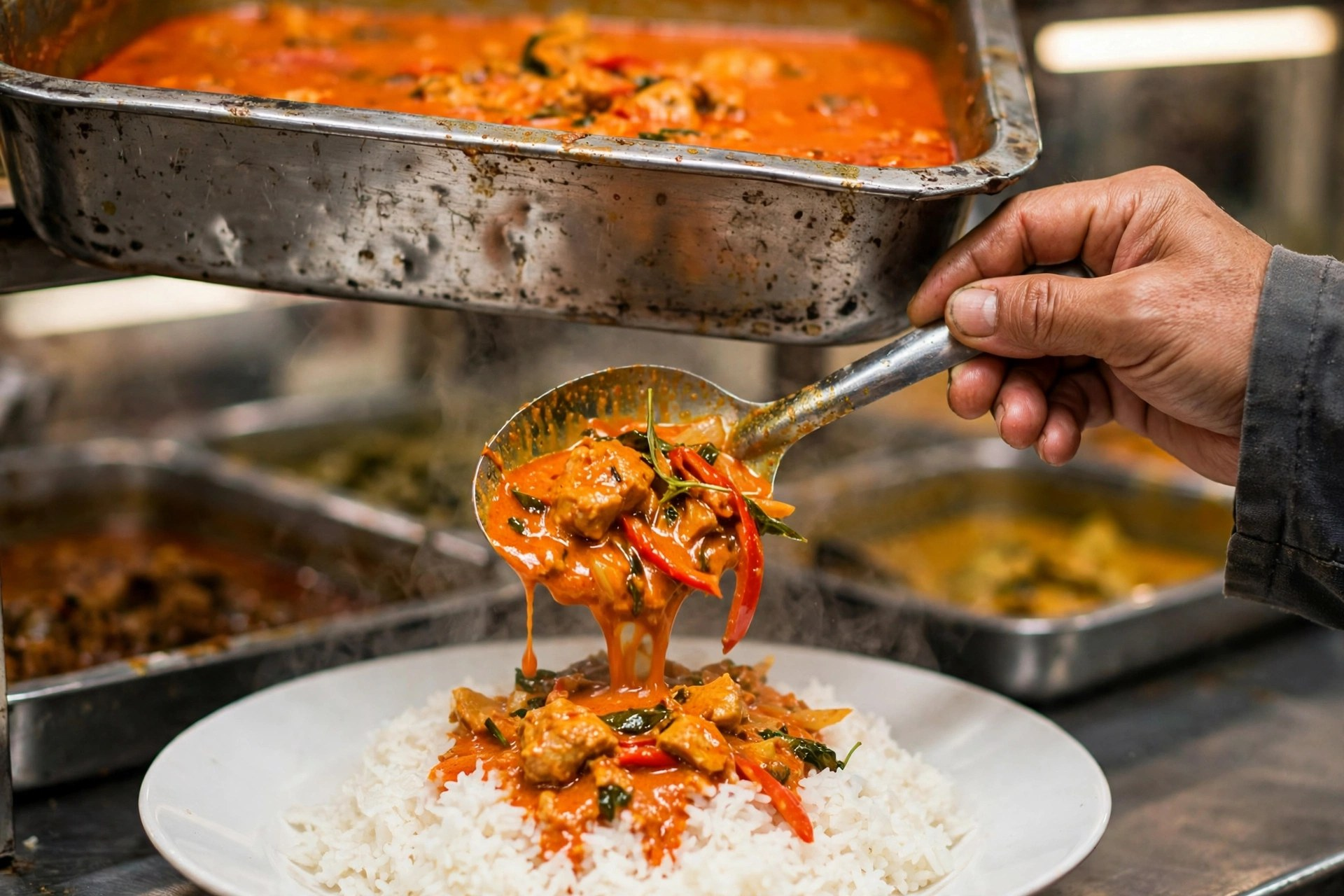
It is half past eleven on a weekday in Bangkok, and the lunch rush is already building. Behind a long stainless-steel counter, a dozen trays sit steaming under glass: a green curry, something deep red and oily, a pale winter-melon stew, a heap of fried eggs with lacy golden edges. There is no menu board and no host stand. You squint at a tray, and the woman in the apron names the dish for you before you can even ask. This is a ran khao kaeng — a rice-curry shop — and it is where a huge share of Bangkok eats lunch on an ordinary day.
Most visitors walk straight past these shops. Foreigners tend to gravitate toward the made-to-order noodle stalls or the restaurants with English menus, and the rice-curry shops, with their unlabeled trays and brisk regulars, can feel like a members-only club. They are not. They are the most democratic eating institution in the city. If you want to understand how Bangkok eats when nobody is performing for tourists, this is the classroom — it only asks that you meet it on its own terms.
The name is the menu, decoded
The name breaks into three words: ran (shop), khao (rice), and kaeng (curry). Literally translated: a shop selling rice and curry. But the “curry” in the name is doing more work than it appears to. Like the “bread” in “give us this day our daily bread” — bread standing in for all food — the word kaeng in ran khao kaeng stands in for every kind of rice accompaniment. Curries, yes, but also stir-fries, braised dishes, steamed things, fried things, soups, relishes. Rice is the constant; everything in those trays exists to be eaten with it.
Some shops also offer khanom chin, thin fermented rice noodles, as an alternative base — mostly meant for ladles of green or red curry, though noodles are less versatile than rice here. What you will not find is anything cooked to order. Noodle soups, stir-fried noodle plates, fried rice made to your specification — that belongs to a different genre entirely, ahan tam sang, the made-to-order shops. A rice-curry shop is about food that is already cooked, already waiting, ready the moment you are.
What you will see in the trays
The spread changes by the day and by the shop, but the grammar stays consistent. Expect a few curries — green, red, maybe a mild yellow kaeng kari — alongside a sour soup or two and a gentle clear broth (kaeng jued, the mild counterweight to everything fiery). There will be braised dishes like khai phalo, eggs simmered in spiced soy broth; stir-fried vegetables and long beans; fried fish or pork with garlic; an omelet or two; and, at the better shops, a chili relish with raw vegetables on the side.
Menus rotate. Most shops cook in the morning and sell until the trays run dry, which means the selection is best — and freshest — when the regulars are eating. A tray that is half empty at noon is a compliment to the shop, not a warning.
How ordering actually works
First, figure out which kind of shop you have walked into. Some are takeaway-only: you point at what you want, and each dish goes into its own plastic bag or foam box, with the rice packed separately. Buy the rice — everything in those trays is seasoned to be eaten with it, and without it the food will taste almost violently salty. At home, it all gets reheated and set out family-style: dishes in the middle to share, rice on each person’s own plate.
If there is seating, you have two moves. The first is the fast one: point at two complementary dishes to be spooned over your rice, composing your own one-plate meal. Asking for “two kinds” — ao song yang — is the standard order. The second is the social one: have the dishes put in separate bowls in the center of the table, everyone with their own plate of rice, and share. It costs more than the one-plate route, but for a group it is the better meal.
One piece of mechanics worth knowing: if you want a soup, it comes in its own small bowl. Spooning a whole bowl of tom yam over your rice next to another dish just makes everything wet and sloppy. And when you are done, you pay — at most shops, after the meal, not before. They keep track.
An honest word about the cooking
Here is the part the travel writing usually skips: the average rice-curry shop is not cooking the best food in Bangkok. It is cooking the most available food in Bangkok, and those are different things. Mediocre shops outnumber good ones by a wide margin, and the truly excellent ones are rare enough that Bangkokians trade their names like secrets.
The measuring stick locals use is simple: how close does it come to home cooking? Anyone who grew up with a good home cook can taste the difference immediately. The khai phalo in the tray may look tempting, but the old-fashioned kind is braised for hours until the seasoning has soaked through the whites and into the very core of the yolks; the shop version, cooked in a hurry, rarely gets there. A curry made with thin, stretched coconut milk is a curry the cook would never serve to family.
Thais themselves were once blunt about this. In the 1970s there was a cutting little term, mae ban thung plastic — the “plastic-bag housewife” — for a woman who fed her family with street-bought food instead of cooking. It was never a compliment. The recent Western habit of glorifying cheap Thai street food as the “real” cuisine has plenty of Bangkokians tilting their heads in confusion, because the locals never confused inexpensive with excellent. If you have read our essay on what “authentic” Thai food really means, you will recognize the pattern: rustic is not a synonym for good, any more than fancy is.
None of this is an argument against rice-curry shops. It is an argument for taking them for what they are — quick, inexpensive, everyday food, no more and no less. Appreciated on those terms, they are wonderful.
Why they matter anyway
Start with the obvious: they are cheap, fast, and everywhere, and the variety is enormous. Office workers eat breakfast and lunch at them and buy dinner to take home on the way out. In a city where young professionals live in condos with one-burner stoves and wimpy exhaust fans, these shops are what dinner looks like most nights. Even the morning alms offerings to monks, once cooked before dawn by the devout, now often come from the nearest rice-curry shop.
Then there is the deeper role: they are a taste of home for people far from it. Plenty of shops specialize in regional cooking — southern dishes, northeastern dishes, and, more rarely, northern ones — so a transplant from any part of the country can usually find the flavors they grew up with somewhere in the city. For people who never learned to cook, or who no longer live with the parents who did, the shops are the most affordable substitute for home cooking that exists.
And for a visitor, a rice-curry shop is a discovery machine. The trays hold dishes you will almost never find on a Thai restaurant menu abroad. Watch how the regulars compose a plate and you start to see how Thais think about a meal — the balancing of flavors and textures that the Thais call a samrap — and which vegetable dishes get paired with which relish. Unless you have Bangkokian friends who cook, this is the closest you will ever get to home-style Thai cooking, a world that is otherwise closed to outsiders.
Tips for your first visit
Go at mealtimes. Turnover is freshness, and a shop doing brisk business at noon is a shop worth eating at. Point at what looks good and smile — “this one, please” (ao an ni) covers nearly every situation. Always get the rice. Watch what the regulars order; the dish half the room is eating is the dish the shop is known for.
And set your expectations the way a Bangkokian would. This is probably not going to be the best meal of your trip. It might be the most ordinary one — and in its own way, the most revealing. A city shows its true appetite not in its famous restaurants but in what it eats on a Tuesday at noon, standing or sitting on a plastic stool, in a hurry, for the price of pocket change.