Cooked salmon in fridge has a short timer. Most leftovers stay safe for only 3 to 4 days in a refrigerator kept at 40°F (4°C) or below. That surprises a lot of people, especially when the fish still looks fine. If you’re staring at a leftover fillet and trying to decide “eat it or toss it,” here’s the clear answer, plus how to store it, reheat it, and spot trouble early.
How long does cooked salmon in fridge last?
Here’s the short answer you probably came for:
Cooked salmon lasts 3 to 4 days in the fridge if you refrigerated it within 2 hours of cooking and your fridge stays at 40°F (4°C) or colder.
That’s the standard food safety window backed by USDA-style leftover guidance. It applies to baked salmon, grilled salmon, pan-seared salmon, and most cooked salmon meals you made at home or brought home from a restaurant.
If the salmon sat out too long, the clock changes fast.
| Situation | Safe call |
|---|---|
| Cooked salmon refrigerated within 2 hours | 3 to 4 days |
| Left out at room temp more than 2 hours | Discard it |
| Left out more than 1 hour above 90°F (32°C) | Discard it |
| Frozen after cooking | Best quality for 2 to 3 months |
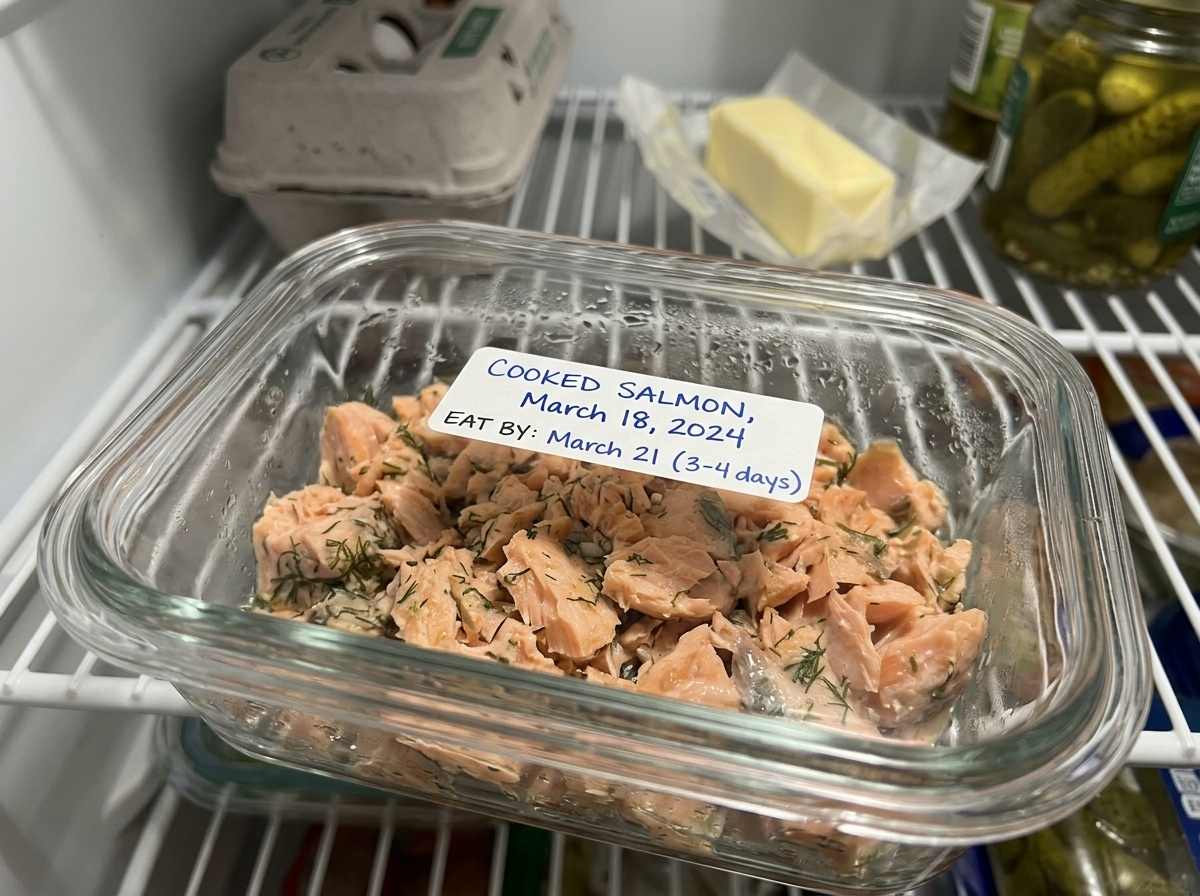
A simple rule helps: label the container with the date. If you cooked it on Monday, aim to eat it by Thursday. That cuts out the guessing game later.
Quick fact: The fridge slows bacteria down. It doesn’t stop them. Think of it like hitting the brakes, not the pause button.
How to store cooked salmon in fridge safely
A lot of people focus only on the number of days. Fair enough. Still, storage matters just as much as the calendar.
Cool it within 2 hours
The safest leftover salmon is the salmon that gets chilled quickly.
After dinner, don’t leave the fillet on the counter while you watch a show, answer emails, and clean the kitchen “in a minute.” That’s how good food turns risky.
If the salmon is still in one big piece, cut it into smaller portions. Smaller pieces cool faster. Put them in shallow containers, not one deep tub. Deep containers trap heat in the middle, and that gives bacteria more time to grow.
You also don’t need to wait for salmon to become stone-cold before refrigerating it. That old kitchen advice confuses a lot of people. Warm leftovers can go into the fridge. Just use smaller portions so they cool faster and don’t heat up the whole shelf around them.
Pro tip: If you meal prep salmon for several days, portion it the same day you cook it. One container per serving makes reheating easier and keeps you from warming the same batch again and again.
Use the right container and the coldest steady spot
The best setup is simple: an airtight container or tightly wrapped salmon in foil or plastic wrap, then placed inside a sealed container or zip-top bag.
That does two things. It keeps the fish from drying out, and it keeps the fridge from smelling like salmon every time you open the door.
Try not to store it in the fridge door. The temperature jumps around there because the door opens and closes all day. A middle or back shelf is steadier.
Did you know? Many home fridges run warmer than people think. A cheap fridge thermometer can save you from bad leftovers. For safety, keep the fridge at 40°F or below. For better quality, many people aim closer to 37°F to 38°F.
If you’re not sure your salmon was fully cooked in the first place, check this guide on how to know when salmon is done. Safe leftovers start with properly cooked fish.
Restaurant leftovers count too
Brought home salmon from a restaurant? The same 3-to-4-day rule applies, but the timer started when the food was served, not when you finally got it into your own fridge.
So if your salmon sat on the table during dinner, then rode home in the car, don’t treat it like a fresh-cooked meal that just came out of your oven. Its safe window may already be shorter.
The same goes for takeout left in the bag on the counter. If it sat too long, don’t save it “just for tomorrow lunch.”
Smoked salmon can confuse people
Not all salmon is the same.
A cooked salmon fillet is one thing. Smoked salmon can be different, especially if it’s cold-smoked. Some people assume all smoked salmon is fully cooked, and that’s not always true. If you’ve ever been unsure about that, this piece on is smoked salmon cooked or raw clears it up.
If you opened packaged smoked salmon, always check the label first. Packaged seafood can have its own storage rules, and the package instructions beat general advice.
Meal-prep bowls have more than one clock
Maybe your leftover salmon is sitting on rice with veggies and sauce. In that case, don’t look at the salmon alone. The whole meal matters.
Rice, for example, has its own food safety timeline. If you pack salmon bowls for lunch, it helps to know the storage rules for cooked rice in the fridge too.
One weak link can spoil the whole meal.
How to tell if cooked salmon in fridge has gone bad
This is where most people start negotiating with themselves.
“It smells okay.”
“It was only one extra day.”
“I can just reheat it.”
That little internal debate usually means you already don’t trust it.
Signs your cooked salmon has spoiled
Bad salmon often gives you clues. Look for a mix of these signs:
Smell: Fresh cooked salmon may smell rich or mildly fishy. Spoiled salmon smells sour, sharp, rotten, or ammonia-like.
Texture: Good leftover salmon should still feel firm or flaky. Bad salmon often turns sticky, slimy, or mushy.
Color: Watch for dull gray patches, greenish spots, or mold. Any fuzzy growth means it’s done. No debate.
Liquid in the container: A little moisture can happen. Thick, cloudy, or odd-smelling liquid is a bad sign.
Not every dry-looking piece is spoiled, though. Dry edges can just mean the salmon spent a day or two uncovered or wasn’t wrapped well. That’s more of a quality issue than a safety issue. Still, if it’s dry and old and smells off, don’t try to rescue it.
Why the sniff test isn’t enough
Smell matters, but it’s not the whole story.
Some harmful bacteria don’t announce themselves with a dramatic odor. Food can be unsafe before it smells obviously bad. That’s why time and temperature matter more than your nose alone.
Think of the smell test like checking the sky before a storm. It can give you a clue, but it doesn’t replace the weather report.
If your salmon is on day 5 or later, don’t rely on “it smells mostly fine.” That’s not a solid plan.
Warning: Reheating spoiled salmon does not make it safe. Heat may kill some bacteria, but it won’t undo toxins that may already be there.
Common misconception: “If I cook it again, it’ll be fine”
A lot of people believe a hard reheat fixes old fish. It doesn’t.
If the salmon sat out too long or has already passed the safe fridge window, reheating only makes hot bad salmon. It doesn’t reset the clock. Your fridge isn’t a time machine, and your oven isn’t a reset button.
Can you eat cooked salmon after 4 or 5 days?
This is one of the most searched questions for a reason.
People don’t want a food science lecture. They want a yes-or-no answer.
Day-by-day, what’s realistic?
On day 1 and day 2, leftover salmon is usually at its best. The texture is still good, and the flavor hasn’t faded much.
On day 3, it’s still usually fine if you stored it properly and kept the fridge cold.
On day 4, you’re at the edge of the usual safety window. If it looks and smells normal and it was stored the right way, many people will eat it that day. I wouldn’t push it past that.
On day 5, the safe answer is no. Toss it.
Could some people eat day-5 salmon and feel fine? Sure. People also drive on bald tires and get home safely sometimes. That doesn’t make it a smart rule.
A real-life example
Say you baked six salmon fillets on Sunday for meal prep.
If you cooled them fast, packed them well, and kept them cold, Sunday through Wednesday is your sweet spot. Thursday is the outer edge. If you know by Tuesday you won’t finish them all, freeze the extra portions right then. Don’t wait until Thursday night and then try to “save” them.
That small move protects both safety and taste.
Be extra careful for high-risk groups
If you’re serving leftover salmon to a young child, an older adult, someone who is pregnant, or someone with a weak immune system, don’t get casual with the timeline.
For those groups, being strict is the better call. If there’s doubt, throw it out.
Food safety note: This article is general food guidance, not medical advice. If someone eats spoiled fish and develops symptoms like vomiting, diarrhea, stomach cramps, or trouble breathing, contact a healthcare professional right away.
Best ways to reheat cooked salmon without drying it out
Safe is one thing. Pleasant to eat is another.
Leftover salmon goes dry fast, which is why so many people think they hate reheated fish. Usually, the problem isn’t the fish. It’s the reheat method.
Reheat it low and slow in the oven
If you want the best texture, the oven wins.
Set the oven to 275°F. Put the salmon in a baking dish, add a spoonful of water, broth, butter, or lemon juice, and cover it loosely with foil. Heat it for about 10 to 15 minutes, depending on thickness, until it’s hot.
For the safest route, leftovers should reach 165°F internally. A food thermometer helps here, especially with thicker pieces.
This method is gentle, and it keeps the fish from turning into dry orange chalk.
The microwave works if you’re careful
Need lunch fast? The microwave is fine if you don’t blast it.
Use 50% power if your microwave allows it. Cover the salmon loosely and heat it in 30-second bursts. Check it often. Stop as soon as it’s hot.
Overheating is the main reason reheated salmon tastes harsh and smells stronger than it should.
A skillet can freshen it up
A pan on low heat works well too, especially for flaked salmon you want to turn into tacos, fried rice, or a quick salmon scramble.
Add a tiny bit of oil or butter, keep the heat low, and cover the pan for a minute or two. You’re warming it through, not frying it all over again.
Yes, you can eat cooked salmon cold
A lot of people ask this quietly, like it might be weird. It’s not weird at all.
If the salmon was stored safely and is still within the 3-to-4-day window, you can eat it cold straight from the fridge. It’s great in salads, sandwiches, wraps, or rice bowls.
If you’re cooking a fresh batch instead of reheating leftovers, this guide on bake salmon at 400 can help you get a good result the first time.
Can you freeze cooked salmon from the fridge?
Yes, and freezing is smart if you know you won’t eat it in time.
Freeze it early, not at the last minute
The best moment to freeze cooked salmon is as soon as you know you won’t use it within a couple of days. Don’t keep it in the fridge until it’s almost too old, then freeze it to dodge the deadline.
That doesn’t really solve the problem.
For best quality, cooked salmon usually keeps well in the freezer for about 2 to 3 months. It may stay safe longer if continuously frozen, but the texture often drops off after that.
How to freeze it well
Wrap each portion tightly or use airtight freezer containers. Press out extra air if you’re using freezer bags. Label each pack with the date.
Single portions are best. You can pull one out for lunch without thawing a giant frozen block.
A little sauce or glaze helps protect the texture too. Plain salmon dries out faster in the freezer than salmon tucked into a curry, grain bowl, or pasta dish.
Thaw it the safe way
Thaw cooked salmon overnight in the fridge, not on the counter.
If you’re starting with raw fish instead of cooked leftovers, the timing is different. This guide on thawed salmon in the fridge explains that part clearly.
Once thawed, eat it soon and reheat only what you need.
Common mistakes people make with cooked salmon in fridge
Most salmon storage mistakes aren’t dramatic. They’re small habits that stack up.
Leaving it out “just a little longer”
This is the big one.
Dinner ends. The pan stays on the stove. Then the phone rings. Then dessert happens. Then someone says, “We’ll pack it later.”
Two hours disappears quickly. At summer cookouts or hot kitchens, the safe window shrinks to one hour if the temperature is above 90°F.
If salmon sat out overnight, throw it away. Not “smells okay.” Not “I’ll reheat it really well.” Just toss it.
Storing it in a warm fridge
You can do everything else right and still lose the safety battle if your fridge runs warm.
An overpacked fridge, bad airflow, or a weak thermostat can leave food sitting above the safe zone. That’s why a basic fridge thermometer matters more than people think.
Reheating the same portion again and again
If you keep pulling out one big container, reheating some, cooling it again, and putting it back, the quality drops fast. Safety can slip too.
Portion it once. Reheat once. Life gets easier.
Mixing old salmon with fresh salmon
Don’t top off yesterday’s leftovers with today’s new batch in the same container. Keep them separate so you know which one is older.
Sounds obvious, right? Yet it happens all the time in real kitchens.
Pro tip: Write the cook date on painter’s tape or a sticky label. It takes five seconds and saves you from the “wait, which day was this?” problem later.
- FAQ Section
Frequently Asked Questions
How long is cooked salmon good in the fridge?
Cooked salmon is usually good for 3 to 4 days in the fridge if you stored it within 2 hours of cooking and kept the refrigerator at 40°F (4°C) or below. After that, the safe answer is to discard it.
Can I eat cooked salmon after 5 days in the fridge?
It’s not recommended. Day 5 is past the usual safe window for cooked fish and other leftovers. Even if it smells fine, it’s better to toss it.
Can you eat cooked salmon cold from the fridge?
Yes. You can eat cooked salmon cold if it was stored properly and is still within the 3-to-4-day fridge window. Cold leftover salmon works well in salads, wraps, and bowls.
What’s the best way to store cooked salmon in the fridge?
Store it in a shallow airtight container or wrap it tightly and place it on a steady cold shelf, not in the fridge door. Label it with the date so you know exactly how long it has been there.
Can you freeze cooked salmon after refrigerating it?
Yes, but freeze it while it’s still fresh, not after it’s already at the edge of the safe window. For best quality, use frozen cooked salmon within 2 to 3 months.
Does reheating cooked salmon make it safe again if it’s old?
No. Reheating does not fix spoiled salmon or salmon that sat out too long. If it has passed the safe fridge window or shows signs of spoilage, discard it.
- Conclusion
If your cooked salmon in fridge is within 3 to 4 days, stored cold, and still looks and smells normal, you’re usually fine. If it’s been sitting there longer, or it spent too much time on the counter before chilling, don’t try to talk yourself into it. Toss it and move on. Next time, date the container the moment it goes in the fridge. That one tiny habit saves a lot of second-guessing.