Cooked shrimp doesn’t give you much room for guessing. One extra day in the fridge can turn a smart leftover into a food safety risk. If you’re staring at shrimp pasta, shrimp cocktail, or last night’s stir-fry and asking how long does cooked shrimp last, the short answer is 3 to 4 days in the fridge. The real trick is knowing what changes that timeline, and when “it still smells okay” isn’t good enough.
Cooked shrimp lasts 3 to 4 days in the fridge
Here’s the straight answer: cooked shrimp lasts 3 to 4 days in the refrigerator if you store it properly.
That matches current USDA and FoodSafety.gov guidance for cooked fish and shellfish. Your fridge should stay at 40°F (4°C) or below, and you should refrigerate the shrimp within 2 hours of cooking. If the room is really hot, around 90°F (32°C) or higher, that safe window drops to 1 hour.
A lot of people want a simple rule they can remember. Use this one:
| Storage spot | Safe time for cooked shrimp |
|---|---|
| Fridge at 40°F or below | 3 to 4 days |
| Freezer at 0°F or below | Best within 2 to 3 months |
| Room temperature | Up to 2 hours |
| Room temperature above 90°F | Up to 1 hour |
Quick Fact: The 3-to-4-day clock starts when the shrimp is refrigerated, not when you notice it again in the back of the fridge.
So if you cooked shrimp on Sunday night and packed it away right after dinner, plan to eat it by Wednesday or Thursday. If you left it on the counter for half the evening, that timeline changes fast.
People often think seafood should be eaten by the next day. That’s a bit too strict for properly stored leftovers. On the flip side, plenty of people push shrimp to day five or six because it “still looks fine.” That’s where trouble starts. Shrimp is one of those foods that deserves less guessing and more common sense.
If you’re still working with uncooked seafood, check this guide on how long raw shrimp lasts in the fridge. Raw and cooked shrimp follow different storage rules, and mixing them up is a common mistake.
What affects how long cooked shrimp lasts?
Time and temperature matter most
If you remember only one thing, remember this: bacteria grow fast between 40°F and 140°F. Food safety people call that the danger zone.
That means your shrimp can start becoming risky long before it looks bad. A plate of garlic shrimp left on the stove while everyone keeps talking after dinner? That counts. A shrimp platter sitting out at a party for three hours? Also counts.
The fridge helps, but only if it’s actually cold enough. A lot of home fridges run warmer than people think. If your refrigerator is overstuffed, opened all day, or set too warm, your leftovers won’t last as long as you expect. A cheap fridge thermometer can save a lot of guesswork.
The timing before storage matters just as much. Letting shrimp cool for a few minutes is fine. Letting it sit out “until later” isn’t. You don’t need to wait for it to become fully cold before refrigerating it. Just get it into a container and chill it while the clock is still on your side.
Does sauce, shell, or takeout change the answer?
A little, but not enough to change the main rule.
Plain sautéed shrimp, grilled shrimp, shrimp in Alfredo, shrimp fried rice, and shrimp tacos all still land in that 3-to-4-day fridge range if you stored them the right way. Sauce doesn’t make shrimp last longer. If anything, rich sauces can hide spoilage smells.
Did you know? Garlic, butter, lemon, and chili can cover up the warning signs of bad seafood. Your nose helps, but your calendar matters more.
Shell-on cooked shrimp doesn’t buy you much extra time either. Same deal with peeled shrimp. Once it’s cooked, refrigerated, and treated like a leftover, use the same rule.
Restaurant takeout follows the same timeline too. Some people think food from a restaurant lasts longer because it came from a commercial kitchen. It doesn’t. Once you bring that shrimp home, it becomes leftover food just like the shrimp you cooked yourself.
There’s one more angle that people miss: the starting freshness matters. If the raw shrimp was already near its limit before you cooked it, the final dish may lose quality faster. Cooking doesn’t magically turn old seafood into a long-lasting food. It gives you a normal cooked-food window, but it won’t fix shrimp that was already going downhill.
How to store cooked shrimp so it lasts
Right after cooking
Storing cooked shrimp well isn’t hard, but the small details matter.
Here’s the easiest way to do it:
- Let the shrimp stop steaming heavily for a few minutes.
- Move it to a shallow airtight container.
- Refrigerate it within 2 hours.
- Keep your fridge at 40°F or below.
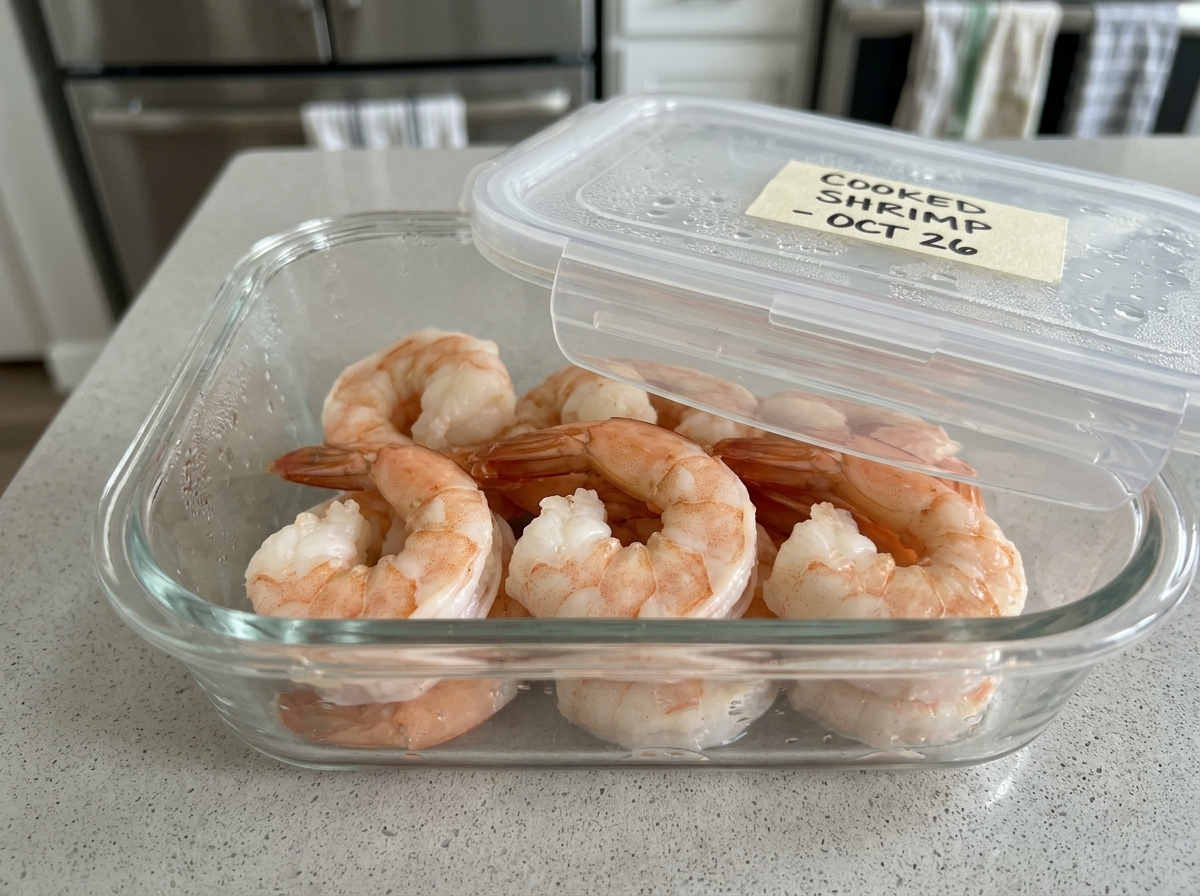
- Label the container with the date if you won’t eat it the next day.
That shallow container part matters more than most people realize. A big deep bowl full of hot shrimp cools slowly. Slow cooling gives bacteria more time to grow. A flatter container chills faster and more evenly.
Pro Tip: Put the date on the lid with masking tape. It sounds basic, but it saves the whole “Was this from Monday or Tuesday?” debate later.
Try not to store shrimp in the refrigerator door. That area warms up every time you open it. The middle shelf usually stays more stable.
Storing shrimp dishes, takeout, and party trays
Leftover shrimp rarely sits by itself. It usually shows up in pasta, rice, salad, tacos, or a cold shrimp cocktail tray.
If your shrimp is mixed into rice, store the whole dish promptly and follow the same leftover rule. Rice has its own food safety issues too, so it’s smart to read up on how long cooked rice lasts in the fridge if you meal prep shrimp bowls or fried rice.
Shrimp cocktail is a little trickier because it often sits out during parties. If it stayed on a solid bed of ice and remained very cold, you may still be okay to refrigerate it. If the ice melted and the shrimp warmed up, don’t try to save it.
Takeout shrimp needs the same kind of attention. If you brought home shrimp lo mein at 8 p.m. and left the carton on the counter until midnight, that food has already spent too much time out. Reheating later won’t undo that.
For shrimp tacos, salads, or grain bowls, it helps to store wet toppings separately if you can. Lettuce, herbs, and sauces can make the whole dish soggy, which doesn’t always mean unsafe, but it does make it harder to judge quality later.
A good rule? Cool it fast, cover it well, and don’t make leftovers work harder than they should.
How to tell if cooked shrimp has gone bad
Red flags you shouldn’t ignore
Spoiled cooked shrimp usually gives you a few warnings. The problem is that people often ignore the first one because they don’t want to waste food.
If your shrimp shows any of these signs, toss it:
- Sour, sharp, or ammonia-like smell
- Slimy or sticky surface
- Mushy texture
- Dull color or odd discoloration
- It’s been in the fridge longer than 4 days
Fresh cooked shrimp should smell mild and a little briny, not punchy or harsh. A strong “fishy” smell is a bad sign, especially if it hits you right when you open the container.
Texture matters too. Shrimp can be firm and still tender when it’s good. If it feels slimy, tacky, or weirdly wet, don’t talk yourself into eating it.
Color can be a clue, but it’s not always the first clue. Cooked shrimp should look pink, white, or lightly opaque depending on the variety. If it turns dull gray, yellowish, or develops strange spots, skip it.
Warning: Don’t taste shrimp to test whether it’s safe. One bite of bad seafood isn’t worth it.
Common confusion: overcooked, undercooked, or spoiled?
A lot of people mix these up.
Overcooked shrimp feels rubbery and dry. That’s a quality problem, not always a safety problem. If it was cooked properly and stored on time, rubbery shrimp may still be safe to eat.
Undercooked shrimp is different. It may look translucent, grayish in the center, or soft in a way that feels raw rather than tender. If you’re not sure whether your shrimp was fully cooked from the start, this guide on how to tell when shrimp is cooked can help. You can also check the right shrimp internal temp if you want the food-safety number.
Spoiled shrimp is about storage time and bacterial growth after cooking. It may smell off, feel slimy, or simply be too old. And here’s the tricky part: spoiled shrimp doesn’t always scream for attention. A creamy sauce or spicy marinade can cover a lot.
Common misconception: If cooked shrimp smells okay, it must be safe.
Real life is messier than that. Time and temperature beat the sniff test.
If you’re pregnant, older, immunocompromised, or serving young kids, give yourself even less room for guessing. Questionable seafood should go straight to the trash.
Can you freeze and reheat cooked shrimp?
Freezing cooked shrimp the smart way
Yes, you can freeze cooked shrimp.
If you know you won’t eat it within the fridge window, freezing is the better move. Try to freeze it while it still tastes fresh, ideally within the first day or two after cooking. Don’t wait until day four and then freeze it as a rescue mission. By then, the quality is already slipping.
For best texture, store cooked shrimp in a freezer bag or airtight container with as much air removed as possible. Smaller portions work better than one big block. You can thaw only what you need.
Cooked shrimp stays best in the freezer for about 2 to 3 months. If it stays frozen at 0°F (-18°C) the whole time, it remains safe longer, but the texture can get dry or spongy.
Seafood leftovers tend to follow the same basic pattern. If you meal prep fish and shellfish often, you’ll notice similar storage timelines in guides like cooked salmon in the fridge and lobster tails in the fridge.
Reheating without turning it rubbery
Shrimp reheats fast. That’s good for safety, but bad if you blast it too long.
The safest move is to reheat cooked shrimp until it reaches 165°F (74°C) as part of a leftover dish. Still, you don’t need to punish it. Warm it gently and stop as soon as it’s hot.
A few easy ways work well:
- Warm it in a skillet over low heat with a little butter, oil, or sauce.
- Microwave it in short bursts, covered, so it doesn’t dry out.
- Add it to soup, noodles, or fried rice near the end so it just heats through.
If your shrimp is already mixed into pasta or curry, heat the dish slowly instead of cranking the temperature. Shrimp goes from tender to rubbery in a hurry.
You can also eat cooked shrimp cold, as long as it was fully cooked, chilled on time, and still within the safe storage window. That’s why shrimp cocktail and shrimp salad work so well straight from the fridge.
One smart habit: reheat only the portion you plan to eat. Repeated warming and cooling makes leftovers age faster and taste worse.
A simple timeline for real-life shrimp leftovers
Easy day-by-day guide
People rarely need a science lesson. They need a simple answer for the container sitting in the fridge right now.
Here’s a practical way to think about it:
Day 0: You cook the shrimp and refrigerate it on time.
Day 1: Great quality. Eat cold or reheat.
Day 2: Still very good if stored well.
Day 3: Usually fine, but check smell, texture, and storage history.
Day 4: Last reasonable day for most leftovers.
Day 5: Don’t risk it. Toss it.
That’s the easy version, and honestly, it works for most homes.
If you froze the shrimp on day 1 or day 2, the clock basically pauses. Once you thaw it in the fridge later, use it within a few days and don’t let it linger again.
Real examples you can copy
Let’s make it even simpler.
You cooked shrimp stir-fry on Sunday night and packed it into the fridge before bed. Best plan? Eat it by Wednesday or Thursday.
You ordered shrimp pasta on Friday, got home at 7 p.m., and refrigerated it by 8 p.m. You should finish it by Monday or Tuesday.
You served shrimp cocktail at a baby shower from noon to 4 p.m. and it sat on the table most of the time. That shrimp is done. Don’t save it.
You made shrimp fried rice for lunches but realize on Tuesday that you won’t finish it by Thursday. Freeze the extra portion right away rather than hoping you’ll “get to it.”
That’s usually the real decision people are trying to make. Not “what’s the general rule?” but “should I eat this now, freeze it, or toss it?”
If you can’t remember when you cooked it, that tells you a lot already. Food should not need detective work.
4. FAQ Section
FAQ
Can I eat cooked shrimp after 5 days in the fridge?
Usually, no. Cooked shrimp is best used within 3 to 4 days if it has been refrigerated properly. By day 5, the risk goes up even if it still looks okay. Seafood isn’t a good place to push your luck.
How long can cooked shrimp sit out at room temperature?
Cooked shrimp can sit out for up to 2 hours at normal room temperature. If the room is above 90°F, keep that to 1 hour. After that, bacteria can grow fast, and reheating won’t make it safe again.
Can you freeze cooked shrimp?
Yes. Freeze cooked shrimp in an airtight container or freezer bag for best quality within 2 to 3 months. Freeze it while it’s still fresh, not after it’s already near the end of its fridge life.
Can you eat cooked shrimp cold from the fridge?
Yes, if it was fully cooked, refrigerated on time, and is still within the 3-to-4-day window. That’s why cold shrimp cocktail, shrimp salad, and chilled shrimp bowls are common. If anything smells off or feels slimy, toss it.
Does reheating old shrimp make it safe again?
No. Reheating can kill some bacteria, but it won’t reliably fix shrimp that sat out too long or stayed in the fridge too many days. If the shrimp is already questionable, heat won’t save it.
Does shell-on cooked shrimp last longer than peeled shrimp?
Not enough to change the rule. Whether the shrimp is peeled, tail-on, or shell-on, the safe fridge window is still about 3 to 4 days once it’s cooked and stored as a leftover.
5. Conclusion
If you remember one number, make it 3 to 4 days. That’s the safe fridge window for cooked shrimp in most home kitchens, as long as you chilled it on time and kept it cold.
The best next step is simple: check the date on your leftovers right now. If you’re close to day four, eat it today or freeze it. If it’s past that point, or anything feels off, let it go. A tossed container of shrimp is a lot cheaper than a bad night with food poisoning.
If you already ate questionable shrimp and feel sick, get medical advice. For everyone else, a label, a cold fridge, and a little honesty with leftovers goes a long way.