A perfectly cooked Korean kalbi rib has this almost magical quality — caramelized on the outside, juicy and tender on the inside, with a sweet-savory glaze that makes you close your eyes and just enjoy the moment. But here’s the thing most people get wrong: they treat kalbi like any other rib, and it’s not. The cut is different, the thickness is different, and the way heat interacts with that thin, marinated meat is completely different from your typical American-style beef ribs.
If you’ve ever pulled kalbi off the grill only to find it rubbery, charred, or somehow both overcooked and chewy at the same time, the problem almost certainly comes down to temperature and technique. Getting those two things right transforms this dish from “pretty good” to the kind of food that makes your neighbors show up uninvited.
Let’s talk about how to actually nail it — from understanding the cut to dialing in your exact cooking temps across different methods.
Understanding the Kalbi Cut (And Why It Matters for Temperature)
Before we even touch a thermometer, you need to understand what you’re working with. Kalbi — sometimes spelled “galbi” — refers to Korean-style short ribs cut across the bone, not parallel to it. Your butcher might call this a “flanken cut.” You’ll typically see three small cross-sections of bone in each strip, with the meat sliced about ¼ to ⅜ inch thick.
This thin cut changes everything about how you approach temperature.
Think about it like this: a thick ribeye steak gives you time. You can sear the outside while the inside slowly comes up to temp. Kalbi doesn’t give you that luxury. The meat is so thin that the difference between perfectly done and overdone might be 30 seconds on a hot grill. That’s why understanding your heat source temperature matters even more than the internal temp of the meat itself.
The bones also play a role. They conduct heat differently than the surrounding meat, which means the areas closest to the bone will cook at a slightly different rate. Not a huge deal with thin cuts, but worth keeping in mind when you’re deciding how long each side needs.
If you’re already familiar with making Korean short ribs kalbi at home, you know the marinade is a big part of the equation too. That sugar content in the marinade — from pear, brown sugar, or honey — means it caramelizes fast and can burn quickly at high temperatures. This directly affects what grill temp works best.
The Right Temperature for Grilling Kalbi
Grilling is the traditional and most popular way to cook kalbi, and it’s where temperature control matters the most. You’re working with direct, high heat and a very thin piece of marinated meat. There’s almost no margin for error.
Your Grill Temperature Sweet Spot
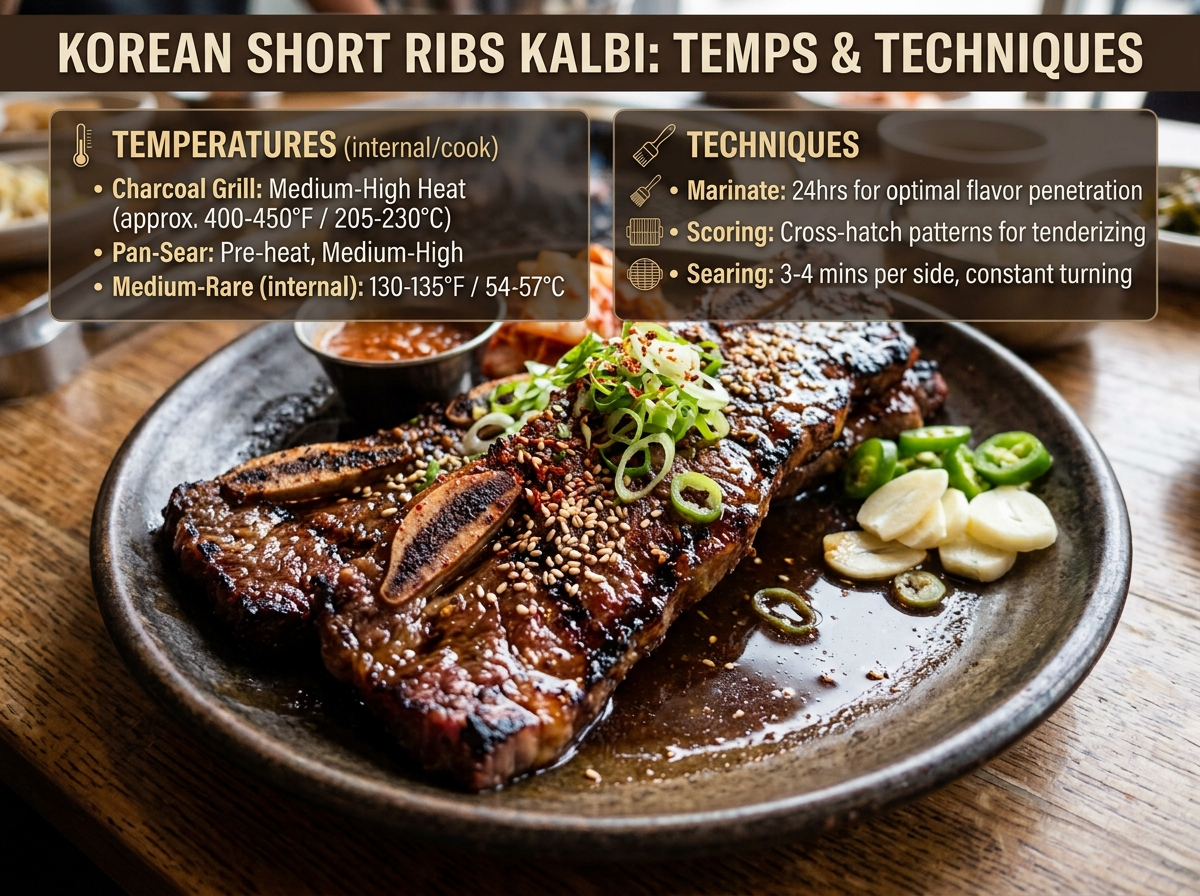
Set your grill to high heat — between 450°F and 500°F (230°C to 260°C). You want those grates screaming hot before the first piece of meat goes down. Why this range? You need enough heat to get caramelization on the sugars in the marinade within 2 to 3 minutes per side. Any lower, and you’ll end up steaming the meat rather than searing it. Any higher, and the sugars burn before the meat cooks through.
If you’re using a charcoal grill, this means a full chimney of lit coals spread in an even layer, with the cooking grate positioned close to the coals. For gas grills, crank all burners to high and let it preheat with the lid closed for at least 10 minutes.
Internal Meat Temperature
Here’s where kalbi gets a bit unconventional compared to other beef cuts. For thick steaks or roasts, you’d normally pull beef at specific internal temperatures — 130°F for medium-rare, 140°F for medium, and so on. But with kalbi sliced ¼-inch thin, sticking a probe thermometer into the meat is practically impossible and honestly unnecessary.
Instead, you’re cooking by time and visual cues. At 450–500°F grill temp, each side needs about 2 to 3 minutes. You’re looking for:
- Visible caramelization and slight charring on the edges
- The meat pulling away slightly from the bone cross-sections
- Juices starting to bead on the surface before you flip
The finished kalbi should be cooked through — this isn’t a cut you serve rare. The thin profile and the marinade penetration mean medium to medium-well (around 145°F to 155°F internal) is actually the ideal range. The connective tissue needs that heat to soften, and the marinade flavors develop better at this doneness level.
Pro Tip: If you absolutely want to check temperature on thicker-cut kalbi (some butchers cut it up to ½ inch), use an instant-read thermometer inserted sideways into the thickest part of the meat, away from the bone. Aim for 145°F for the best balance of tenderness and juiciness.
Managing Flare-Ups
The sugary marinade dripping onto hot coals or burners will cause flare-ups. This is probably the number one reason people end up with burnt kalbi. You have a couple of options here.
Keep a spray bottle of water nearby for charcoal grills — quick, controlled bursts to knock down flames without killing your heat. On gas grills, having one burner turned off gives you a safe zone to move meat temporarily if flames get out of control.
Some grill masters swear by patting off excess marinade before grilling. You won’t lose flavor — the marinade has already penetrated the meat during its soaking time. What you will lose is the excess sugar sitting on the surface that’s most likely to burn and turn bitter.
Kalbi on a Charcoal Grill vs. Gas Grill
Both work, but they behave differently, and your technique needs to adjust.
Charcoal Grilling
Charcoal gives you that authentic smoky flavor that pairs beautifully with the sweet soy marinade. You also get higher peak temperatures and better radiant heat, which means faster, more intense caramelization. Korean BBQ restaurants that grill tableside often use charcoal for exactly this reason.
The tradeoff is less temperature control. Charcoal burns hotter at first and gradually cools, so your first batch of kalbi will cook faster than later batches. Plan to grill your thinnest pieces last when the heat has mellowed a bit, and your thickest pieces first when the coals are at their peak.
Lump charcoal works better than briquettes here. It burns hotter, cleaner, and reaches grilling temperature faster. If you’ve got binchotan (Japanese charcoal), even better — it burns incredibly hot with minimal smoke and almost no odor, giving you the cleanest sear possible.
Gas Grilling
Gas gives you consistency. You set the temp, and it stays there. For a weeknight kalbi dinner where you don’t want to fuss with charcoal, gas is perfectly fine. You’ll sacrifice a tiny bit of that smoky depth, but honestly, the marinade carries so much flavor that most people won’t notice the difference.
One technique that helps on gas: leave one burner off and create a two-zone setup. Sear the kalbi over the hot side, then move pieces to the cooler side if they’re getting too dark before cooking through. This is especially useful if your cuts are on the thicker side.
Oven-Broiling Kalbi: The Indoor Alternative
Don’t have a grill? No problem. Your oven’s broiler can produce excellent kalbi, and in some ways, it’s actually easier to control than a grill.
Setting Up the Broiler
Position your oven rack about 4 to 6 inches from the broiler element. Set it to high broil and let it preheat for 5 minutes. Line a sheet pan with foil (trust me, you’ll thank yourself during cleanup — that marinade turns into a sticky, caramelized mess) and place a wire rack on top.
The wire rack is important. It lifts the meat off the pan, allows air circulation underneath, and lets excess marinade drip away rather than pooling around the meat and steaming it.
Broiling Time and Temperature
Most broilers run between 500°F and 550°F, which is perfect for kalbi. Cook for 3 to 4 minutes per side, keeping a close eye on it the entire time. Broilers are unforgiving — 30 seconds too long and you’ve crossed the line from caramelized to carbonized.
The kalbi is done when you see bubbling caramelization on the surface and the edges start to crisp up. If you’ve got thicker cuts, you might need an extra minute per side, but always watch rather than walking away. Broiling is not a “set it and forget it” situation with this much sugar in the marinade.
Quick Tip: Crack your oven door open about an inch while broiling. Many ovens cycle the broiler element on and off when the door is closed (to regulate temperature), but keeping it cracked maintains constant high heat for a better sear.
Smoking Kalbi: Low and Slow or Hot and Fast?
Smoking kalbi is a bit unconventional — it’s not the traditional approach — but it’s become increasingly popular, especially among BBQ enthusiasts who want to add another layer of flavor. The question is: do you go low-and-slow or hot-and-fast?
Hot and Fast Smoking (Recommended)
For flanken-cut kalbi, hot and fast is the way to go. Set your smoker to 275°F to 300°F and cook for about 45 minutes to 1 hour, flipping once halfway through. You’ll get smoke penetration without drying out the thin meat.
Fruitwoods like cherry or apple work beautifully here. They complement the sweet marinade rather than overpowering it. Hickory and mesquite are too aggressive for this particular application — they’ll clash with the delicate balance of soy, sesame, and fruit in the marinade.
If you enjoy smoking thin-cut meats, you might also like experimenting with Asian sticky wings or Asian pork burnt ends on the smoker — similar sweet-savory profiles that take well to smoke.
Low and Slow Smoking (For Thick English-Cut Short Ribs)
If you’re working with thick, English-cut short ribs (single bone, cut parallel) rather than thin flanken-cut kalbi, low and slow becomes viable. Smoke at 250°F to 275°F for 5 to 7 hours until the internal temperature hits 200°F to 205°F. At this point, the collagen has fully rendered and the meat will be fall-off-the-bone tender.
But be honest with yourself — at this point, you’re not really making traditional kalbi anymore. You’re making Korean-marinated smoked short ribs, which is its own wonderful thing. Just know the distinction.
Pan-Searing Kalbi on the Stovetop
Sometimes you want kalbi and you want it now. A cast iron skillet can deliver great results in under 10 minutes of active cooking time.
Getting Your Pan Right
Heat your cast iron skillet over high heat until it just starts to smoke — you’re targeting around 450°F to 500°F surface temperature, similar to your grill target. Add a thin film of a high-smoke-point oil like avocado oil or grapeseed oil.
Here’s the critical technique: don’t crowd the pan. Cook the kalbi in batches, leaving at least an inch between each piece. If you stack the pan, the temperature drops dramatically, moisture gets trapped, and you end up steaming the meat instead of searing it. Steamed kalbi is pale, flabby, and tastes nothing like what you’re going for.
Each piece needs about 2 minutes per side over high heat. You should hear an aggressive sizzle the entire time. If the sizzle dies down, your pan has cooled too much — remove the meat, let the pan recover, and start again.
The Fond Is Flavor
After cooking your kalbi, you’ll have a gorgeous layer of caramelized marinade stuck to the bottom of the pan. That’s called fond, and it’s liquid gold. Deglaze with a splash of rice vinegar or mirin, scrape it up, and drizzle it over the finished ribs. It adds a concentrated hit of flavor that you won’t get from any other method.
This pan-searing approach also works great if you’re building a complete Korean spread. While you’ve got the stovetop going, it’s easy to prepare something like Korean-style bok choy in a separate pan, or whip up a batch of ssam sauce for wrapping the ribs in lettuce.
The Marinade Factor: How It Affects Your Cooking Temperature
We’ve touched on this, but it deserves its own section because the marinade isn’t just flavoring — it fundamentally changes how kalbi cooks.
Sugar and Heat
Traditional kalbi marinades contain significant sugar — from Asian pear, brown sugar, honey, or a combination. Sugar caramelizes between 320°F and 360°F and burns above 380°F. Your grill grate surface can easily exceed 500°F when sitting directly over hot coals. That’s why you see such rapid color development on kalbi.
The practical takeaway: don’t walk away from your kalbi. Not even for a minute. The window between perfect caramelization and bitter, burnt sugar is incredibly narrow.
Acid and Tenderness
Most marinades also contain acid — rice vinegar, citrus juice, or the natural acidity in Korean pear. This acid partially breaks down the meat’s surface proteins during marinating, which means the exterior of the meat cooks faster than you might expect. It’s already “softened” before it hits the heat.
This is why over-marinating kalbi is a real problem. More than 8 to 12 hours in an acidic marinade and the surface turns mushy — it falls apart on the grill and can develop a mealy texture. Four to six hours is the sweet spot for most kalbi marinades.
Soy Sauce and the Maillard Reaction
The amino acids in soy sauce accelerate the Maillard reaction — that’s the chemical process responsible for browning and developing complex flavors on the meat’s surface. This means kalbi browns faster and more deeply than unseasoned beef at the same temperature. It’s one reason kalbi develops such incredible color even in a short cooking time.
If you enjoy working with these Korean flavor profiles, gochujang chicken uses many of the same principles — high heat, sweet-savory glaze, fast cooking — with a spicy twist.
Resting Kalbi: Does It Matter for Thin Cuts?
You’ve probably heard the advice to rest your steak after cooking. The idea is that the muscle fibers, which tighten during cooking, need time to relax and redistribute juices. For a thick steak, resting for 5 to 10 minutes makes a noticeable difference.
But kalbi is ¼ inch thick. Does resting matter?
Honestly, not much. The meat is so thin that it cools very quickly, and the juice redistribution happens almost instantly. A 1 to 2 minute rest while you pull the remaining pieces off the grill is plenty. Don’t let kalbi sit for 10 minutes — it’ll go cold, and cold kalbi fat starts to solidify, which kills the texture.
Did you know? In Korean BBQ restaurants, kalbi is typically eaten immediately — cut with scissors right on the grill and eaten within seconds. That’s not just tradition; it’s actually the best way to experience the texture and flavor at their peak.
Temperature Troubleshooting: What Went Wrong?
Let’s run through the most common kalbi temperature mistakes and how to fix them.
Your kalbi is burnt on the outside but raw near the bone. Your grill was too hot, or the ribs were too thick for direct high heat. Drop your temperature by 25–50°F, or move to a two-zone setup where you sear first, then move to indirect heat to finish.
Your kalbi is cooked through but has no caramelization. Your grill wasn’t hot enough, or you had too much moisture on the meat’s surface. Make sure you shake off excess marinade, preheat your grill fully, and don’t close the lid (closing the lid traps steam and prevents browning).
Your kalbi is tough and chewy. Two possibilities. Either it was undercooked (the connective tissue didn’t have time to soften) or severely overcooked (the muscle fibers seized up and squeezed out all moisture). For thin-cut kalbi, the sweet spot is that medium to medium-well range — 145°F to 155°F internal.
Your kalbi tastes bitter. The sugar in the marinade burned. This happens above 380°F surface contact temperature sustained for too long. Manage flare-ups, remove excess marinade before cooking, and flip more frequently if needed.
Serving Temperature and Side Pairings
Kalbi should hit the table hot — ideally within a minute or two of coming off the heat. The fat needs to still be liquid, and the caramelized surface should still have a slight tackiness to it.
For a proper Korean spread, think about pairing with items that contrast the richness of the ribs. Steamed rice absorbs the juices beautifully. A bright, acidic kimchi cuts through the fat. Korean kimchi dumplings (mandu) make an excellent appetizer while you’re grilling. Fresh lettuce leaves for wrapping, thinly sliced garlic, sliced jalapeños, and a good ssamjang or ssam sauce round out the table.
If you want to go all out, Korean fire chicken with cheese alongside kalbi creates an incredible spread that covers both sweet-savory and spicy profiles.
FAQ
What temperature should I grill kalbi at?
Grill kalbi over direct high heat at 450°F to 500°F. This temperature range provides enough heat to caramelize the sugary marinade quickly — within 2 to 3 minutes per side — without drying out the thin-cut meat. Preheat your grill fully before cooking, and keep the lid open to prevent steaming.
How do you know when kalbi is done?
For flanken-cut kalbi (¼ to ⅜ inch thick), look for visual cues rather than relying on a meat thermometer. The surface should show bubbling caramelization with slightly charred edges, and the meat should have firmed up but still feel pliable when pressed. If you can check temperature, aim for 145°F to 155°F internal for the best texture.
Can you overcook kalbi?
Absolutely. Because kalbi is cut so thin, overcooking happens fast. Even 30 to 60 extra seconds on a hot grill can push the meat from perfectly tender to tough and dry. The sugars in the marinade will also burn and turn bitter if left too long. Stay close, watch carefully, and pull the ribs the moment you see proper caramelization.
How long should you marinate kalbi before cooking?
Four to six hours is ideal for most kalbi marinades. The acid in the marinade (from pear, citrus, or vinegar) tenderizes the meat, but marinating longer than 12 hours can break down the surface too much, resulting in mushy texture. If you’re short on time, even 2 hours will give you decent flavor penetration on thin-cut ribs.
What’s the best wood for smoking kalbi?
Fruitwoods like cherry or apple are the best match for kalbi’s sweet-savory marinade. They add a mild, slightly sweet smoke that complements the flavors rather than overwhelming them. Avoid strong woods like mesquite or hickory, which can overpower the delicate balance of soy, sesame, and fruit in the marinade.
Your Next Move
Getting kalbi right really comes down to respecting what makes this cut unique. It’s thin, it’s marinated with sugar, and it cooks incredibly fast. Match your heat source to those realities — screaming hot for grilling and broiling, moderately hot for smoking — and you’ll produce ribs that taste like they came from your favorite Korean BBQ spot.
Start with the grill method if you’re new to kalbi. It’s the most traditional, the most forgiving (you can always pull a piece off early), and it gives you the best flavor. Once you’ve got that dialed in, experiment with the broiler for weeknight dinners or the smoker for weekend projects.
And don’t forget: kalbi is social food. It’s meant to be cooked in batches, eaten hot, shared with people you like being around. Get your temperatures right, keep your tongs in hand, and enjoy the process as much as the plate.